Showing posts with label Magical Realism. Show all posts

Sunday, July 20, 2025

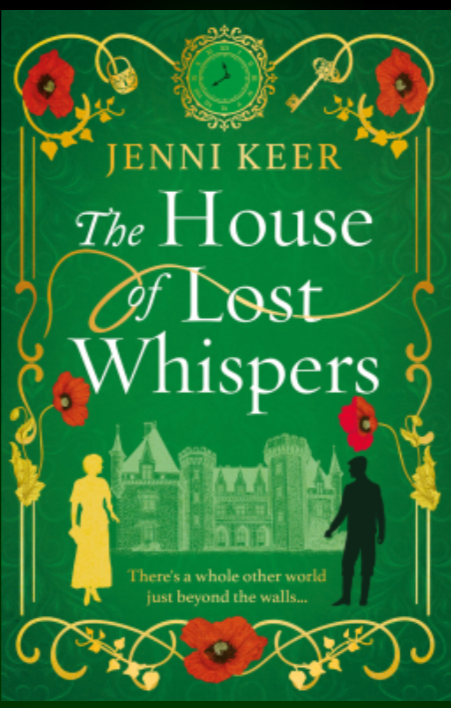
Book Review: THE HOUSE OF LOST WHISPERS


Title: The House of Lost Whispers

Author: Jenni Keer

Publisher: Boldwood Books

Pages: 378

My GoodReads Rating: ⭐⭐⭐


In 1912, thirteen-year-old Olivia Davenport is orphaned when her father, author Jasper Davenport, and mother Selina die on the maiden voyage of the Titanic. Olivia is invited to live with her father’s friend, Sir Hugo Fairchild and his wife Cynthia and their four sons, Clarence, Louis, Howard and Benji, at their lavish home, Merriford Manor.

The new house becomes the setting for Olivia’s overactive imagination, which she uses to deal with her grief, imagining that her parents aren’t dead but that they have lost their memories and will someday find their way to her.

Moving to an unused part of the mansion, Olivia has the initially unsettling experience of being able to hear and converse with a man called Seth who seems to be living on the other side of the wall in her tower bedroom. Both think the other is a ghost or a product of their overwrought imaginations.

Meanwhile, with the war breaking out in Europe, Sir Hugo and Lady Cynthia watch with increasing dismay and sorrow, as one by one, three of their sons go to war and never return.

It’s only after the war that Olivia realizes that Seth lives in another world where her parents are alive. And now she wants to get to that other world. But how can she find a way into his world?


I liked Olivia, her imagination, her contentment in her solitude, her longing for her parents, her faither, her larger than life outlook, her willingness to stand up for the bullied, Benji. These are the traits that get her in trouble, pushing some of the events forward, particularly in the fate of Seth, the undergardener.

I liked that Olivia wasn’t coy but knew exactly what she wants with regard to her future and the role she wanted to play in it. That she imagines a life for herself that isn’t limited to marriage and keeping house. But the scene in which she pleasures herself and explores her own sexual awakening was unreal and completely out of sync with the reality of an older teenager in the aftermath of World War I.

Among the others, the only one I liked was Lady Cynthia, who had the only developing character arc to speak of. From being standoffish and reserved, she learns to show affection, to get past her hangups. It’s a pity she ceased to play a role in Olivia’s life in the section called After the War.


I was a little uncomfortable with the scenes between Olivia, as a child, and Seth, because of the vast age difference between the two. While these scenes are driven by her imagination, there is no explanation for why Seth should turn out to be the one big love of her life.


It’s also more than a little strange that Olivia, no stranger to grief after the death of her parents and then the death of her fiancé soon after, should suddenly forget him, and begin to imagine that a guy she really doesn’t know all that well is the one great love of her life. What’s more, she is not even mildly curious about her parents who are alive and well in the other world.


The novel suffers because it tries to become too many things at once. Until the 23 percent mark, nothing happens. When things start happening, the novel starts shifting from one genre to another.


In the first part, Before the War, we get a hint of magical realism. This part of the novel is more than a little bulky. While the boys are away, and Olivia is basically entertaining herself, these scenes and chapters were boring and ordinary. Nothing of any significance happens during this period.


In Part II, During the War, we get historical fiction, and even war fiction, of sorts. This was the part I liked the most. The author brings out well the sense of bravado and adventure with which young men went out to the battlefront, unaware of the horrors that awaited them. The victorious nations found themselves just as broken as those they had defeated.

Through Clarence, the author gives us her views on the utter futility of war. Clarence says, “As a species, why are we so destructive?”

His mother tells him, “Poetry won’t sustain you in the trenches,” when poetry is sometimes the only thing that has the power to get us through the dark times.


In Part III, After the War, the brief hint of magical realism returns, then gives way to romance and a bit of a mystery, when Olivia tries to uncover why Seth’s old love suddenly disappeared.


This is where the problem arises, with the book trying to be several books at once. The back-of-the-book synopsis gives us a sense of this being a time-slip, parallel world issue, but in time, the romance between Olivia and two other characters takes precedence. I was disappointed by this turn.


Also, the parallel world bit doesn’t show up until quite deep into the book, when we have almost despaired of even seeing it. The explanation of how the parallel world came into being was interesting, but then it was sidelined and the story ended up being just another historical romance.


The idea of another world being created out of nothing, a world in which the Titanic did not crash, unleashing a whole different set of possibilities and history, was interesting, but wasn’t explored on a larger scale. All we are left with is a world in which Olivia’s parents did not die, but the World War still took place.


It would have been better if the author had found some way of getting Olivia to the other world where her parents lived. Instead, we get a muffling of the parallel world in favour of making do with the current one.


I also disagree with the notion that Olivia and Seth are the same in both worlds. A person’s nature and character are heavily influenced by their experiences. An Olivia that had not known grief and sorrow would grow up to be very different from one that had. It would have been better if the book had ended without the forced and rushed happy ending.


(I read this book on NetGalley. Thank you to the author, the publisher and NetGalley.) 

Wednesday, October 04, 2017

Book Review: THE LUSTER OF LOST THINGS

Title: The Luster of Lost Things
Author: Sophie Chen Keller
Publisher: GP Putnam's Sons
Pages: 304
My GoodReads Rating: ⭐⭐⭐⭐⭐


Everyone makes the mistake of assuming that Walter Lavender Jr is slow. Only his mother, Lucy, knows his strengths, his patience, his curiosity and kindness.

Walter has a unique talent, one that beats his weakness. His mouth is shut and the pathways of his mind remain locked. But his eyes are wide open. When he speaks, it is bursts of sounds – swapping consonants and dropped syllables and odd groupings.

At age seven, he discovers the ability to find lost things. After all, he knows the pain of loss, knows what it is like to yearn for a missing piece. His dad, Walter Lavender Sr, went missing when the flight to Bombay that he was co-piloting disappeared just days before young Walter was born. Yet, the child doesn’t stop looking. There is no giving up on a lost thing, even if it has been 12 going on 13 years.

And so he is best equipped to find lost treasure. There is a moment of incredulity, when a treasured thing becomes a lost thing.

He hones his skill, and very soon he has clients for who he helps find lost things: a bassoon, a CIA identity card, socks, a pair of thimbles, a cockatiel. While Walter helps put people in touch with their missing pieces, he faces his own struggles. His personal feelings of inadequacy stemming from the fact that he lacks something, a voice and a Dad.

And even though he doesn’t find his dad, he keeps looking. He knows that unwanted and lost or missed look the same but are different, and that lost things are bridges. They are connections to some other time or place or person or feeling.


Little acts of kindness are at the heart of this story, as they are in the world.

At first, the confectionery shop that Lucy sets up has no customers. But then she reaches out in kindness to a homeless artist, who gifts her a book of drawings, a Book that draws magic into the little shop. Customers begin to flood in, but not everybody sees the shop. It is only visible to those who need its magic.

Business improves, and Lucy hires Jose to do deliveries, and Flory to clean. Life is good. Flory does not need to rely on her coupons alone, and Jose can get his son’s tumour removed, and his own teeth fixed, if funds permit. 

The shop is their haven, until the new landlord issues an ultimatum: agree to pay double the rent or clear out by the month-end. They have two days to decide.

Just as Lucy agrees to pay the new rate, the Book goes missing, and the magic in the shop evaporates. The crowds disappear. Lucy’s disappointment is a fragile crack like an egg dropping onto the floor.

Only Walter, finder of all things lost, could help find the book. But he has only one day to achieve the impossible. 

All alone in New York, and this 12-year-old only has Milton, his dog, for company.

And so begins an adventure.

Will Walter find the book and restore the magic? And will he ever meet his father?


So many questions that Walter won’t even think about. All he knows is that he must find the Book, all seven pages, or risk losing his home forever. 

Along the way, he gets sidetracked as he helps Lan, an old Chinese woman, get home, interacts with Nico, a man who lives in a cardboard box, a rat couple who live in an abandoned subway station, Junker, who collects junk, and an art student, Ruby Fontaine, among others.

With each new interaction, this boy who could barely speak learns a valuable lesson: That is what real bonds require – not just listening and taking in but also giving back some of yourself in kind.

He also realizes, Does that mean that as isolated as I feel, alone on the waters, I only need to cast a light and look around to see that we are all a part of the same ocean, the same story?


The book is written in the first person present tense point of view of Walter.

The beauty of the writing lies in how it succeeds in making the mundane appear magical. The book is awash with sounds we miss and aromas that open up sensations and memories.

What is most heartening is that we never feel the slightest pity for Walter. Instead we are swept off into his world, which is far richer than ours could ever be. We want to reach into the pages of this book and hug this precocious lad who scarcely knows what a gift he is.


I savoured the reading of the words in this story. 

Watching a school, Walter tells us, The kids pour out like spilled birdseed.

When he finds what he is looking for, Joy pours into me like melted sunlight, or relief descending around my shoulders like a peppermint mist.

At one place, he observes of a man, He makes a gruff, sad noise like loosening the regret stuck to the back of his throat.

How do secrets feel? Like cinching a drawstring and the two of us pulled closer together by our shared knowledge.


There were so many things I liked about this book, besides the beautiful prose.

I liked the way the author slips in stories about the things Walter helped find.

The descriptions of the cake mixing were heavenly. I loved them.

Walter’s baking metaphors are everywhere. When he cuts circles into the chessboard squares, he says, it’s like removing chocolate turtle cakes from their ramekins.

But the best thing about this book was undoubtedly Walter. He carries a notebook about into which he writes short phrases, the distillations of his feelings and experiences. At the end, a dream worth waking up for. Through the course of his search, he faces love and fear and anger and loneliness, but he also finds courage and vulnerability and connection and conviction.

The story takes us into Walter’s world where he makes himself small and quiet and invisible. His slowness and the silence it forces upon him help him to see and make connections others might miss.

Right away we know that Walter is special, that he is not like most people who talked without thinking, just opening their mouths to release a volley of words like arrows. He can see The skin of the world as it gilded and stretched and caught glimmers of the underlying bones and gears. He can sense the disappointed hiss of something doused before it could be said.

For a 12-year-old, Walter understands that everyone loses things...the elderly when they forget and the young when they don’t pay attention and the middle-aged when there are too many things to do.


The Luster of Lost Things is a delectable story that reminds us that the kindness we show is the kindness we receive. That is the truest magic there is.

Yes, Walter’s Book has magic, but The Luster of Lost Things has its own blend of magic that left a warm impression on me.


(I got a free ARC from FirstToRead).

Wednesday, August 16, 2017

Book Review: THE LIAR'S WEAVE

Title: The Liar's Weave
Author: Tashan Mehta
Publisher: Juggernaut Books
Pages: 330


Zahan Merchant is born in 1904 to a Parsi family in Bombay. In this alternate world, the lives of humans are written in the stars, and mapped and charted by powerful astrologers, In-Betweens, who can tell you the year in which you will die and the facts of your life, based on the date, time and place of your birth. In their words, Everything happens, as it should happen, because it has already happened.

But the astrologers are powerless to interpret Zahan’s future, for, it seems, that the gods erred this once and Zahan has been born without one, or more accurately, and confusingly as astrologer Narayan Tarachand discovers, with almost infinite futures.

Tarachand takes the problem to his In-between friends, Krishna and Svasa.

The error of the gods gives Zahan his power: he can alter the weave of the future with his lies, a talent he discovers at age 7. It is a secret that he shares only with older brother, Sorab.

But there is a catch. Sometimes it is a power he has, and sometimes, it’s a power that frightens him. For he cannot see the realities he creates for others. Knowing the truth nullifies the effect of the lie.

There is a forest, Vidroha (Hindi for protest, rebellion), deep in the heart of Bombay, which is home to the hatadaiva, the ill-fated. Here Yaatri, a nomad from the Banjara tribe; Liling, Chinese medicine woman; acrobat Tamarin and his wife, Jia, both from the circus, hold court, inspired by Niyat, half-man, half-legend. They give succour to other ill-fated, while yearning to break the stranglehold of fate.

Yaatri meets Zahan and his best friend, Porthos, both 16, and invites them into Vidroha, hoping Porthos will re-write their fate. Meanwhile, the Sapta Puri, the seven holy universities, are equally interested in Zahan and how he alters the weft and warp of life.

Already new realities are coming about. Fortunates are suffering; the ill-fated have flashes of luck. But can you interfere with reality without suffering the consequences?

Vidroha’s desire to change their destinies will destroy lives. And neither Zahan nor Tarachand, who uses Zahan’s power to his own advantage, will come out of this unscathed.


The novel integrates ancient Indian myths with Hindu mythology, creating characters and locales that are part-truth and part-fiction, interspersing the mundane with the cosmic. It shows us how the lives of human beings pan out, while the astrologers attempt to play god. These are lines for us, lives for them, Tarachand chides himself. And yet, as the omniscient narrator reminds us, No matter what the wisdom of the stars, human imagination is stronger.

As a premise, it is intriguing and frightening. In the wrong hands, a power like Zahan’s could wreck lives. Horoscopes and birth charts are one belief that Parsis take as seriously as Hindus. But in this world, it seems, that everyone is held captive to the birth chart.


The story is written in the present tense, in the third person PoV of the characters. Interspersed with the main narrative are excerpts from Tarachand’s book, The Perspective of an In-between.

The similes used in the writing are earthy. Beard like unspun cotton. The prose is evocative, stylized, not as ordinary people might speak. But this is a fantastic world, and so it feels right.


The novel is set in Hindu Colony, Parsi Colony and in Vidroha, besides Benares. The writing in Vidroha is rich and dense, decadent and lush, while that in the two residential colonies is almost genteel, sparse and succinct, in comparison.

The story is set against the backdrop of the struggle against the British for independence. Zahan initially wants to use his dancing tongue to guide the fate of his country. But the struggle for Independence is merely a placeholder. In this alternate world, the astrologers study individual lives; they will not study the fate of the country, the narrator tells us.

There are a few historical facts that come up. The fact that the British introduced the Criminal Tribes Act, a piece of legislation that threatened the diversity of India and pronounced Yaatri and his people, the Banjaras, and hundreds of other tribes criminal.

Beyond a few cursory mentions, the author tells us nothing about it. And that made me feel cheated. Why not just make it a story about a boy who can lie the truth into existence? Why bring the fate of a country into the mix, if you do not mean to take it to its just conclusion?


The names of the leading characters, Yaatri, Tamarin, Liling, Umaan were unreal, fictional, and yet they seemed relatable. Yaatri signifies the journey, Porthos is a character from The Three Musketeers, while Zahan is as Yaatri describes him, Zzzz-haan. Like a bee and an exhale.

The characters have their own compulsions. Porthos wants to know if he is hatadaiva. The others in Vidroha want their ill-fortune transformed.

Tarachand, whose future decrees that he could be Dagdhavasta, head of Sapta Puri, is bothered by the anomaly of Zahan. If the gods have missed him, what else have they missed? If the gods have intended him, what is the purpose of that intention?

The author, young as she is, has a firm grasp of the emotions of the characters, as they struggle in vain to live their lives. The bond between the two brothers, Zahan and Sorab, was poignant, and I felt for Zahan, and the loss of his relationship with Sorab.


The world is being made anew, with every word from a liar’s mouth.

The author treats us to the psychology of the lie. You cannot, absolutely cannot, break eye contact… You must believe your lie, with every ounce of fibre you possess. Love it, nurture it, trust it.

The best lies are the ones between two truths.

What is a lie but a fictional story? And here, stories are described as The currency of your soul.


The novel teases you, confuses you but you bide your time, for as the narrator has told you, Secrets have to ripen before they can be diced; mysteries brew before they clear.


My beloved St Xavier’s College features in this book. Beyond it, it was fascinating to read about Bombay, my favourite city. This city lost so much of its character when its spirit was quelled, and it was asked to keep mum.

Mum-bai.

Why is it always women who are asked to shut up?


I was sorry to see Zahan go, at the end of the book. There seemed so much more that would happen in his life. Surely the gods would not let him go his peaceful way.

What is that thing they say about a liar? 
Once a liar... always a liar.


(I received a free copy of this book from Juggernaut Books for the purpose of a fair and honest review.)

Monday, September 12, 2016

Book Review: LITTLE NOTHING

Title: Little Nothing
Author: Marisa Silver
Publisher: Blue Rider Press
Pages: 352


At first thought, you can’t imagine a more ludicrous story. The story of a girl, born a midget, who is artificially stretched to a full height, but then slowly mutates into a wolf girl, before ultimately transforming into a she-wolf, and then being transformed back into a woman. Such a convoluted story couldn’t possibly make any sense. And yet it does.

Little Nothing by Marisa Silver is the story of Pavla, the word for ‘Nothing’ in the unknown language that is spoken in the unnamed country in which she is born. Born to a middle aged childless couple, as a result of the blessings of a gypsy, Pavla’s parents are shocked to know that their child is a midget. 

At first they want to have nothing to do with her. But her winsome ways win them over, and they begin to love her.
However her condition, and the ill-treatment that she receives at the hands of the world, rankles them, and they visit many doctors in search of a cure. Eventually, a quack, Dr Smetanka, devises a torturous contraption that will stretch her to full height. While the ploy works, Pavla mysteriously begins to mutate into a wolf.

Dr Smetanka’s servant Danilo is the first real friend she has outside her home, but although she loves him, and he her, he cannot see past her freakiness. As the circus fortune teller tells them, One of you will be brave, one of you will be a coward. One of you will believe. One of you will doubt.


Eventually, Pavla becomes part of a freak show, attached to a circus, where she and Danilo are exploited by Dr Smetanka. When the bad doctor seeks to rape her, she attacks him in self-defence, completely transforming into a vicious wolf.

Later she joins a wolf pack, mates with the Alpha male and gives birth to four pups. When her mate and three pups are killed by a hunter, she and one pup escape, but are separated.

The writing is exquisite, inviting us into the life and world of Pavla. Over and over again, I found myself reading and re-reading a particularly beautiful turn of phrase. And there were so many of them, I'd probably end up quoting a large portion of the book. I also want to call attention to the cover. It seemed so fluid, in keeping with the shifting form of Pavla, but it also seemed to be wolf hair, seen at close quarters.

Like Pavla, Danilo too is an outcast of sorts, rejected by his parents. But by the time he realizes his love for Pavla, it is too late; she is a wolf, but Danilo proves his love by killing for her. In time, Danilo too begins to grow on us, because of his sheer love that gets him sentenced to the madhouse, where another adventure awaits him, and where he will meet another character that is crucial to the story.

Pavla grabs our hearts and minds in all her forms, whether as a midget, a freak wolf-girl, or as a wolf. We are consumed by the desire to know more about her. We are touched with sorrow at the silences she suffers through her life, a silence that will become a refrain, when a stranger falls speechless in the child’s presence, or when a villager pushes her children behind her skirts as she passes in the narrow market lanes to protect them from what might be catching.


Lines such as these make us want to know just what turn her life will take next. Pavla seems so naïve at the beginning, but she becomes strong as life repeatedly lashes out at her. She has us readers firmly in her grasp, from the moment the midwife tells her mother to picture a flower.


The set of characters are colourful, like no other I’ve seen before.

Václav and Agáta who are first disgusted by this disproportionate dollhouse version of an infant and then entranced by their child.

Boris Hormulka, who wakes Danilo up with a golden shower.

The little nameless animalistic boy, later named Markus, who triggers fatherliness in Danilo.

Dr Smetanka, cruel and utterly immoral and scarily amoral at the same time.

They all seem so real and yet so unreal at the same time. There is something both mundane and magical about life in this little village, so folksy, where the handing over of a used piece of gum becomes a privilege, and yet so universal.

The themes are indeed universal. The tendency of the world to cast out those that do not fit the mould, the desire for love, the duality of our nature that makes us abhor and be fascinated by something at the same time, and how love is often a lie. Love is filled with lies. We like you just the way you are. You are still beautiful. We will always be with you. She believes her parents do not love her less, only that before, she had a child’s notion of love that did not include the small treacheries of delusion and fear and shame.


There are a number of breaks in the narrative. We receive no information about the exact circumstances of her transformation from woman to wolf, and back again. Nor do we know what deep-seated trauma or cause leads to the transformation, but it doesn’t matter. What matters is our slow realization that love, to be love, remains unswerving, even when the object of our affection unwittingly shifts shape and form.

This story, so completely unalike anything we’ve read before, has us enthralled.

I was touched by the way the author brought the story around full circle. The story does not end with the characters getting together, but there is an element of positivity about it, so that you trust that the author will bring it to pass.

In the hands of a good writer, the most unbelievable story can come alive. That is what happens here. The world may shun Pavla for her freakishness. We do not.

When Danilo rejects her early on, we realize the loss is his, and he will live to regret it. And it is fitting that he rues his wrong decision to the very end.

To us, Pavla is a heroine, who fights her way through the circumstances that life dishes out to her, fighting hard and strong to prove herself. In each of the strange events that befall her, we stand true to her, cheering her on.

There’s no doubt that as stories go, this is the strangest of its kind, but you mustn’t let that dissuade you.


Like Pavla, you will soon realize that Nothing is indeed Everything.

(I read an ARC from First To Read.)

LinkWithin

Related Posts Plugin for WordPress, Blogger...