Showing posts with label Murder mystery. Show all posts

Monday, May 25, 2026

Book Review: THE BLACK CAT DETECTIVES


Title: The Black Cat Detectives

Author: Kit Gray

Publisher: Crooked Lane Books

Pages: 304

My GoodReads Rating: ⭐⭐⭐


Mila MacAllister is a 28-yo magician in a small town, Corvin’s Crossing, hoping to make it to the big league. On the morning of her performance, at which she expects to be scouted for a resort that is looking for performers, Mila finds three black kittens, with the mother nowhere in sight, in a box in the alley outside the club where she is to perform. She rescues them and takes them to the vet and decides to adopt them.

That evening, Mila’s successful performance comes to a sudden close when the body of her boyfriend and manager, Brandon, comes crashing through the roof to the stage, with Mila’s pocket knife protruding out of his chest.


The story is written in four PoVs, the 3rd person PoV of Mila and the 1st person PoVs of the three kittens named Bippity, Boppity and Boop. Bippity is female, Boppity is male, and Boop is non-binary. The other two kittens use they/them pronouns while referring to Boop.


WHAT I LIKED:

I liked the emphasis on friendships and the family ties you build for yourself.

I am no lover of cats, yet I was quite amused and intrigued by the antics of the kittens. The characterization of the kittens is done with a gentle touch. Bippity sees herself as a leader, born to lead her siblings. Boppity fancies himself as a great warrior and is always ready for battle. Boop is always gentle, preferring naps and cuddling to anything else. The curiosity, independence and vulnerability of the cats rang true, even though I know very little about cats.

The voices of the three kittens were strong and striking.

The descriptions of the foods cooked by Ms Fi, and Q and Mrs Scarborough all popped off the page.

In terms of diversity, Asia is well represented through Ms Fi and Becca Varma, Mila’s best friend.


WHAT I DIDN’T LIKE:

The focus should have been on the murder mystery. Instead, the cats took up excessive space, causing a lot of repetition, given that there are three kittens and only one Mila.

Why Becca should be a Varma, an Indian origin surname, makes no sense. We see no evidence of her background or culture, making the name tokenish. She might as well have been white.

In keeping with what has almost become the trope of the genre, Mila was both smart and dumb.

I found the conclusion rather tame. The killer wasn’t convincing enough, nor was their rationale for killing.

The Physics-based superpowers of the kittens weren’t very clear.

Mila’s back story was minimal. It was unclear why she left her parents’ home. They neglected her, and led their own lives, but her trauma suggested something far worse. Also, where and how she learnt magic was something that wasn’t explained.


WHAT DIDN’T QUITE WORK:

In one place, Bopp had male pronouns used, possibly a typo that slipped past.

There is a whole chapter set at the vet’s where Mila takes the three kittens. This chapter was wholly unnecessary.


ALL SAID AND DONE:

This was a cozy mystery that ultimately ended up being more cozy and less mystery, with the kittens overshadowing the resolution of the mystery. 


(I read this book on NetGalley. Thank you to the author, the publisher and NetGalley.)

Saturday, May 23, 2026

Book Review: A MOST PECULIAR PROVIDENCE


Title: A Most Peculiar Providence

Author: Angela Hunt

Publisher: Hunt Haven Press

Pages: 428

My GoodReads Rating: ⭐⭐⭐


Twenty-six-year-old Joshua Donnelly lives in a small town called Peculiar, with his mother. He handcrafts wooden toys for a living. When she passes away unexpectedly due to a stroke, his world is upended. He decides to fulfill her last wish that he “fill the house with love” by getting a dog, Hoss.

Meanwhile, Heather Thomas and her boyfriend, Brett Steelhawk, of three years, are homeless and busking together near Peculiar. Heather is pregnant but Brett doesn’t want the baby. On their last day in town, she miscarries and then finds that Brett has abandoned her.

When Sarah, a vagrant, gives birth to a baby girl, she gets Heather to promise to hand over her baby to someone kind in Peculiar who will look after the baby. With no choice, Heather leaves the baby outside Josh’s front door. What happens next? Will Josh look after the baby? And is there any hope for Heather?

When Hoss digs up a human bone in Josh’s backyard, the past threatens to overshadow Josh’s happiness in the present. Who is responsible for the crime? And will Josh pay for it?


The story is told from the first-person past-tense PoV of the town police chief as well as in the third-person omniscient past tense.


WHAT I LIKED:

The story had a warm, fuzzy vibe to it from the very first sentence. I felt as if I knew and loved the characters. I particularly loved the similes:

Like loose change in a coffee tin.

Frost glazed the glass, glittering like crushed sugar.

This story had slipped past me like a cat burglar in socks.


I liked the character of Josh, even though he came across as a little odd. It was sweet that he got Hoss, a huge English mastiff, because he promised his mother that he would fill the house with love.

I particularly liked the scenes between Josh and baby Maggie. The narrator, through Josh’s actions, tells us how easy it is to care for an infant. You fed them, you changed them, you held them close. You kept them safe. You loved them.


Some more quotes that I liked:

When you pull on the past, it doesn’t come back gentle. It comes back hungry.

Sometimes when a man stops pacing, it means he's found a place to stand.

Order is a comforting thing, but it’s fragile. And when it cracks, strange, even miraculous things have a way of slipping through.


The book ends with fun recipes for Hoss’s Favourite Dog Treats, Josh’s Bologna Sandwiches, Josh’s Grilled Cheese Sandwiches and Mama’s Homemade Lasagna, all written with dollops of affection and humour intertwined with life lessons and some easy philosophy.


WHAT I DIDN’T LIKE:

I felt a little note of dissonance when Heather and Josh met. Josh was so kind, and Heather’s animosity felt forced. Of course, the reasons are explained later, but I never got over my dislike of her.

There is an element of the fantastical that runs through this book, which is unfortunately not pursued. We learn early on that Josh has the power to heal, but it isn’t used with any kind of significance. The fact that he has the power to heal should have played a greater role in the plot.


WHAT DIDN’T WORK FOR ME:

The story felt very old-fashioned, even though it is set in 2006. There was no mention of mobile phones or the Internet or anything that would root it in this century.


ALL SAID AND DONE:

This was a sweet and gentle story well told.


(I read this book on NetGalley. Thank you to the author, the publisher and NetGalley.)

Saturday, April 18, 2026

Book Review: THE HOTEL MAID


Title: The Hotel Maid

Author: Michelle Dunne

Publisher: Storm Publishing

Pages: 264

My GoodReads Rating: ⭐⭐⭐


In the Prologue, we meet June Calloway, a maid who has been working in the Cedarwood Manor Hotel for the last six years, who finds a dead body, Mrs Erica Kelly, in Room 208. When she calls Lauren at Reception to inform her about the dead body, she learns that Mrs Kelly’s 10-year-old daughter, Mia, is missing and that the police are on their way.

Chapter 1 then takes us back in time to a period Six weeks earlier, when June finds a note in her locker, saying, “I know what you did. Keep your mouth shut.” June, who believes in working hard and keeping her mouth shut, has her secrets, but she can’t imagine who might be warning her. Who could have left her the note? Could it be Malcolm Levy, the security head, whose grandparents own the hotel? Or Liz, the hotel manager, who is in a relationship with Malcolm? Soon there is another note with the single word, Killer.

The only support that June receives comes to her from Tess, who lives in the apartment she has rented.

Meanwhile, Mia, the adoptive daughter of Erica Kelly, is subjected to horrible child abuse and mean gaslighting at home.


The book is written in the 3rd person past tense PoV of June and Mia. On the face of it, there is nothing to tie the stories of June, Mia and Tess together. There’s nothing really graphic but the book hints at child abuse, sexual abuse, verbal abuse, self-harm and even paedophilia.


WHAT I LIKED:

The author kept us on tenterhooks. There were several mysteries going on at once. What was June’s past? What did Erica Kelly want?

My heart went out to Mia. Her account made for painful reading. She was such a sweet child, yet so vulnerable, going through challenges no child should have to go through. It was sad to see a child being told untruths and lies, and her then building her self-image based on those lies. The humiliation and the belittling that she is subjected to, despite the hard work that she puts in to cook three meals a day for the family and clean the house. I enjoyed the embodied writing in Mia’s PoV. The end of Chapter 20 especially made me want to wreak violence on Erica. I certainly connected more with Mia’s POV than with June’s.

The narration by Jacqueline Milne was very well done, with every voice sounding different and tuned to the situations of the plot.

One quote I really liked in this book: Turns out nobody in this bloody story is who they say they are.


WHAT I DIDN’T LIKE:

The book takes on disturbing overtones towards the end.


WHAT DIDN’T WORK FOR ME:

There is no mention of any cell phones in the novel so it is hard to figure out a timeline. At one point, Mia mentions that she has read the news about Paris Jackson’s suicide, and since that happened around 2013, it gives us some idea, but the complete absence of cell phones throws us off.

The book raises certain questions that aren’t answered. At around 10 years of age, Mia cooks and cleans for the whole family. She was brought into the house when she was a very small child. Who looked after her then? Who cooked and cleaned for the family then? Also, who taught little Mia to cook, clean and keep house?

The identity of the person leaving the notes was never clarified. Towards the end, June has a suspicion about who might have done it, but she has no evidence. Nor does her theory seem plausible.


ALL SAID AND DONE:

It took rather long to make its point, but it was an enjoyable read.


(I read this book on NetGalley. Thank you to the author, the publisher and NetGalley.)


Saturday, November 08, 2025

Book Review: I CAME BACK FOR YOU


Title: I Came Back For You

Author: Kate White

Publisher: Thomas & Mercer

Pages: 299

My GoodReads Rating: ⭐⭐⭐


Bree Winter, 53, is living in Uruguay with her partner, Sebastian. She is in a good place and healing from the trauma of her past life. Eight years ago, her college-going daughter Melanie was killed by a ruthless serial killer, Calvin Ruck. In the aftermath of that horror, Bree and her husband Logan Chase drifted apart as he sought to manage his grief through infidelity.

In the present time, Logan has donated an enormous sum of money towards two scholarships and the renovation of the editorial office of the college’s literary magazine, both in the name of Melanie. Around this time, Ruck, who is serving time for his crimes, has admitted to killing two other women, while asserting that he didn’t kill Melanie.

Now Bree and Logan are thrust once again into the nightmare. She flies up to New York to attend the reception in honour of the scholarships, and begins her own investigation into who might have wanted her daughter dead.


The story is written in the first-person present-tense PoV of Bree.


WHAT I LIKED:

It was good to see a protagonist in her 50s. The fact that she is older than Sebastian by two years is also unconventional and welcome.

Logan came out reasonably well-drawn. Despite the infidelity, he appeared to be a decent character. Bree too came out strong as a mother, torn asunder by grief and desperate for closure, particularly in the second half of the book. The first half, not so much. Given the situation, I liked the note on which the book ended. It made me feel connected to the mother and daughter, after a whole book of struggling with both characters.

There was a smattering of Spanish words and phrases in the chapters set in Uruguay, that I liked.


WHAT I DIDN’T LIKE:

There was far too much filler stuff. The book could have been a lot thinner. The scenes in Uruguay seemed like so much filler. The only reason why it has been put there is probably to justify the title, I came back for you. She came back to New York all the way from Uruguay.

The pace improved only when Bree began her own investigation at the 41 percent mark. But only slightly. Then the pace dropped again, then increased at the 46 percent mark. Then it dropped again, and re-surfaced at 51 percent.

While the author built up Logan, Sebastian remained vague. It didn’t help that we meet him in person on page 1, where he flies off to Buenos Aires, and then we only see him through phone calls, texts and emails. We meet him again at the 96 percent mark. Even Melanie came off as insubstantial. Considering that the whole book was about her parents struggling with grief, we don’t get to see much of her personality. The flashbacks relating to her don’t help.

The challenge that befalls Bree at the 67 percent mark doesn’t seem particularly dangerous.

WHAT DIDN’T WORK:

The writing was good but there were far too many flashbacks, not all of them very relevant to the story. Many of the flashbacks relate to Logan and their marriage. It got in the way of building tension in the present.

The trajectory of the relationships wasn’t hard to predict. In many ways, I saw this book as women’s fiction as much as a murder mystery. Bree spent a long time trying to get a grip on her feelings for her ex and her current partner.

There were some questions that remained unanswered. For instance, why does a particular character lock Bree in the basement office of the literary magazine? Also, why doesn’t the killer kill Bree when they have the chance, despite knowing that she has figured it all out?


ALL SAID AND DONE: The book should have been shorter. As a mystery, it could have been a lot tighter.


(I read this book on NetGalley. Thank you to the author, the publisher and NetGalley.)


Thursday, September 25, 2025

Book Review: THE MURDERER'S GIRL


Title: The Murderer's Girl

Author: KL Murphy

Publisher: Level Best Books

Pages: 308

My GoodReads Rating: ⭐⭐⭐


Gordon Little, whose podcast, Catch a Criminal, went viral with the cold case he last investigated, is now in small-town Hampstead at the invitation of dear friend and ex-girlfriend Lynnleigh Lawson. He plans to investigate and cover on his podcast the cold case of the murders of Lynnleigh’s mother Lisa and Lisa’s best friend, Tina Cox, 15 years ago. Lynnleigh’s father Harry, who insisted he was innocent, that he was in Washington DC at the time, was arrested for the murders.

Fifteen years later, a video has surfaced showing that Harry was exactly where he said he was, absolving him of the crime. Unfortunately, the video has come too late, as Harry died in prison.

Now there are two investigations running parallelly. Detective Callie Forde and Gordon are both running their own investigations, determined to find out who was the real killer and to clear Harry’s name posthumously. But there is someone in town who is determined to put an end to the investigation.

Meanwhile, there is another issue that is plaguing the police. Two houses have been robbed, with some trinkets, a laptop and some cash stolen. Is it a random case or is it connected with the Lawson and Cox killings? And will the truth ever surface?


The story is told in two timelines, 15 years ago and now, and from the 3rd person past tense PoVs of Callie Then and Now, and Gordon Now. Set in a small town, the story has the air of a cozy mystery.


WHAT I LIKED:

I enjoy stories about cold cases, where a long-suffering innocent person is finally acquitted, and so I was eagerly looking forward to this one.

I enjoyed the parts that showed the podcast coming together, and the details shared about what it takes to run a podcast, the equipment etc. Gordon and sound engineer Jeremy made a good team.

Every chapter ended with a mini-cliffhanger, which was nice. The last few scenes had a good spell of action and description, and a brisk pace. Major and minor characters were both drawn out well, giving them the required motivation and increasing stakes. The character that touched me the most was Harry; I wish there was more of him, in flashbacks or in the narrative of the past. Even the old records and testimonies didn’t include any interviews with him.

We get bits of the past in the present, memories which give way to flashbacks, but it was done well enough.

The author brings up the question of the nature of today’s media where opinions and lies are often passed off as fact.

There were some sweet and warm scenes as when Maura, Callie’s mother, tells her the owl story, related to Callie’s grandmother, and another scene, Lynnleigh’s flashback, when Harry tells eight-year-old Lynnleigh that he would always choose her to be his daughter.


WHAT I DIDN’T LIKE:

The initial dump of back story about Gordon, as soon as his character was introduced, was unnecessary.


WHAT DIDN’T WORK FOR ME:

The mystery of who had broken into the houses and how whatever came to be found there had come to be put there in the first place was not adequately answered. We also learn nothing about who released the video that proved Harry’s innocence.

Henderson and Chang were hard to relate to. At the outset, we learn a little bit about them, but then they turn into flat characters, always in the background, never taking any initiative at all.

There were too many characters whose names began with the same letter. For instance, Lynnleigh Lawson’s mother is Lisa Lawson. Then Gordon’s previous case was that of Hamilton Hayes. In Hampstead, another H, for the Lawson case, he meets police officers Henderson, another H, and Chang. A minor character is salon owner Karen Huddleston, another H, who is interviewed by Gordon.

It was odd that even when the story was told from the PoV of Callie Then, the narrative shifted to referring to her mother as Maura, something a daughter would hardly do.


ALL SAID AND DONE: Early on, I had an idea about the identity of the real killer, and it was satisfying to be proved right. I still enjoyed the story and how it was drawn out.


(I read this book on NetGalley. Thank you to the author, the publisher and NetGalley.)

Sunday, April 13, 2025

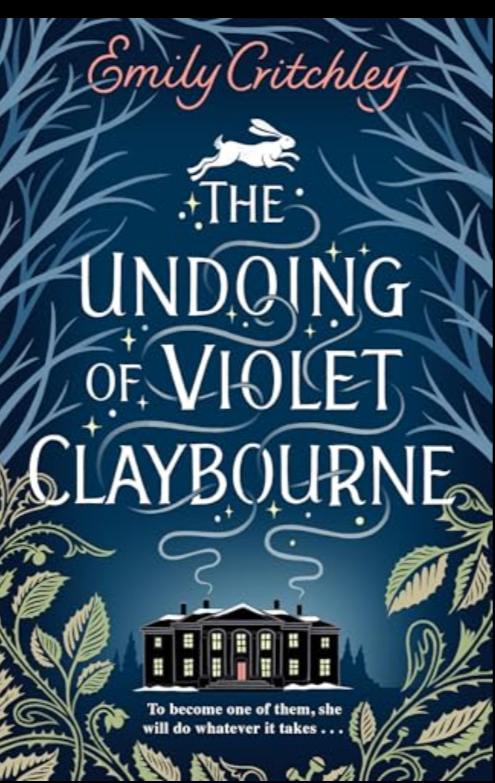
Book Review: THE UNDOING OF VIOLET CLAYBOURNE


Title: The Undoing of Violet Claybourne

Author: Emily Critchley

Publisher: Zaffre

Pages: 349

My GoodReads Rating: ⭐⭐⭐⭐


I love stories about houses, and so when this story came up, I was excited to read and review it.


When the story begins, Gillian McCune, an old woman in 1999, looks back on her childhood, particularly on the fateful days she spent as a guest at Thornleigh Hall, and the part she played in the events that took place there.


Gillian ‘Gilly’ Larking is in her sixth year at Heathcomb school when the privileged Violet Claybourne is admitted there, and they find themselves roommates. Gilly, with no real family and no good friends, is swept off her feet into Violet’s world. The friendship grows quickly with both girls believing in tandem with their Classics lessons, Nos Contra Mundam (Us against the world).

Invited to the Claybourne home, Thornleigh Hall, for Christmas, Gilly becomes enamoured with their world. There she meets Violet’s older sisters, Emmeline and Laura, and her parents, Giles and Olivia Claybourne. Gilly longs to have Emmeline and Laura see her as one of their own, as an equal. At every step, she tries to set herself apart from Violet, and closer to Emmeline and Laura, who are classist and believe themselves superior even to their sister, Violet.

Before the Christmas break is over, Thornleigh Hall will be beset by tragedy, with one life lost and another destroyed. What part will Gilly play in this travesty of justice?


The book is set in 1938, so the shadow of World War I still looms large over the characters. Lord Claybourne and many of the members of the police force have served in the war, but Frank Marks, a gameskeeper who lives on the grounds of Thornleigh Hall, has been a conscientious objector. As the book progresses, the characters find themselves in the middle of World War II.


This is a time when a woman is called upon to make a good marriage, then be a good wife and mother. It is against this background that the Claybourne family hopes that 22-year-old Emmeline will be wooed by the nearly forty-year-old Viscount Cadwallander, who might help save Thornleigh Hall from almost certain ruin.


The bulk of the story takes place between Christmas and New Year. The construction of the period was done well.


The book also makes a mention of post-partum depression and Obsessive Compulsive Disorder (OCD), both conditions for which the medical science of the time might not have had satisfactory answers. Undoing is how Violet refers to the odd rituals she does “to undo what might happen.” The Undoing is Violet’s OCD. It is also a reference to how her life is undone, and how she seeks to undo that wrong.


The chapters end on a note of finality and expectation, inviting us to turn the page. I kept thinking about the events of this book even when I wasn’t reading it, especially about how far the characters deserved the fates that had befallen them.


The author has done a fine job with the descriptions of Thornleigh Hall, the Randolph Hotel, and Heathcomb school.


I can’t remember when I last detested a bunch of fictional people. I despised nearly all the main characters here. In the case of the narrator, Gilly, I must add that this was the first time that I began by liking a protagonist and then went on to change my mind about her. The author does make an effort to redeem her in our eyes, in a later part of the book, but it didn’t work for me.


Only the smaller characters like Frank Marks, a groundskeeper who lives on the property, and Robin, the fatherless son of Mary, the maid, and, to an extent, Violet, left a positive impression on me.


There are scenes featuring elaborate and intense gaslighting that are well written.

I also loved the resonance in the book, the parallels between Gilly and Robin. The fact that they have each lost a parent.


Gilly’s first meal with the Claybournes reveals their habits and characters, the sense of superiority they nurture in themselves. In true upper-class fashion, Laura and Emmeline insist that the foxes enjoy the fox hunt. “You can see it on their faces,” they say, in justification of their own pleasure and lifestyle. I couldn’t help reflecting on the hypocrisy of one of the sisters who hates any show of emotion but thinks nothing of the flutter of disgust that crosses her own face.


The colonial mindset is evident when Violet says about school, “We only learn sums, and which bits on the map still belong to us.”


Gilly, with her tendency to steal and lie, has her own flaws, making her believable.


I felt a sense of sorrow for Violet, for the ‘undoing’ of her at the hands of those she trusted. I hoped the book would not end on a note of wrongdoing and injustice. 


(I read this book on NetGalley. Thank you to the author, the publisher and NetGalley.) 
Saturday, April 12, 2025

Book Review: PORCELAIN (SHADOWS OF HYSTERIA)


Title: Porcelain (Shadows of Hysteria)

Author: Jesse Sprague

Publisher: Cursed Dragon Ship Publishing

Pages: 344

My GoodReads Rating: ⭐⭐⭐


Gabrielle Cross is under therapy and medication to help her cope with the aftermath of a tragedy in the past. She has also previously been institutionalized. Ten years ago, when she was only nine, her parents were found brutally murdered, and she was found covered in their blood. She believed then that it was her porcelain doll, a family antique, that had killed them in order to protect her.

Now Gabrielle is trying to live a normal life, go to college, date. How long will it be before her past catches up with her?

When her date, Joe, takes her home on the very first date and pressures her for sex, she blacks out. When she wakes up, he is dead with stab wounds and noticeable strangulation marks, causing Gabrielle’s past to be brought to the fore again. She is filled with doubts and fears and the only two people who trust her are her half-brother, Michael, and her friend, Peter.

Meanwhile, Michael has begun a relationship with Cole Montez, a bisexual, divorced cop who is going through a bitter legal battle with ex-wife Joan for the custody of their 4-year-old daughter, Isa, while the banks threaten to foreclose on his house.

Then Cole is assigned the case. Will he be able to ensure justice for everyone?


As a child, Gabrielle believed that her doll had committed the murders. Now she is anxious to find answers. Is she really a murderer or could the doll be possessed by an evil spirit?


The book shines a spotlight on mental illness and schizophrenia. Peter is schizophrenic but has sought help and is doing well. Issues of mental health are written about in this book from a place of sensitivity and understanding.


The story is written in the 3rd person past tense PoV of Gabrielle and Cole. For the greater part of the novel, the story shifted between the two PoVs in regularly alternating chapters. At the 38th chapter, we get six consecutive chapters in Gabrielle’s PoV, causing the pace to flag a little bit.


The 3rd person PoV of Gabrielle, with which the story began, drew me into the story. Unfortunately, the second chapter, where we get to know Gabrielle’s half-brother, Michael, through the eyes of his boyfriend, Cole, was completely unnecessary. This chapter appeared to have been put in just to bring us up to speed on the past. Michael tells his new boyfriend (and us) the story of their lives. This chapter nearly put me off reading the rest of the book.


Also Cole’s utter infatuation with Michael was something I found annoying. I almost gave up reading because of this thread in the story. Cole kept thinking that Michael was gorgeous which took away from the main story. Thankfully, the pace improved after the second chapter, and Cole kept his infatuation under wraps.


I found the two men, Michael and Cole, very boring and annoying. Lucinda ‘Cinder’, Gabrielle’s roommate and friend, was a minor character I liked straightaway for her loyalty and sense of friendship.


The author has a good style. The characterization, description, conflict and action are handled well. The description of Peter and Gabrielle standing atop the unfinished building had me feeling queasy. But the horror and supernatural elements were weak.


The book needed to be proofed better. Modicum is a noun, not an adverb as is used here.


After a few chapters, Gabrielle didn’t stay in ‘character’. She stopped mentioning her meds or repeating her affirmations.


Cole’s bisexuality was token, having no bearing on the main plot. Why didn’t the author just make him gay? The romance between Cole and Michael took up too much space.


Also, the doll could have been a lot more menacing. Once the investigation started, we didn’t see any evidence of the horror of the doll for ourselves. It was all in Gabrielle’s flashbacks. The doll on the cover of the book was quite creepy but we don’t get to see her inherently evil nature.


The doll’s relationship with Gabrielle is downplayed. Instead we get to see more of Cole and Michael, Cole and Joan, Gabrielle and Cinder, and Cole and Isa. Even Yolanda, Cole’s nanny, the most minor of the characters, gets more space here.


The dialogue and Gabrielle’s internal monologue get repetitive, with Gabrielle repeatedly wishing herself dead, and wondering if the doll is a part of her or external to her.


Despite the accusation of murder that hangs over her, Gabrielle isn’t put under surveillance. Additionally, Gabrielle’s extended conversation with Peter wasn’t as revelatory as she seemed to think it would be.


Isa is supposed to be 4, but I couldn’t sense her innocence. She appeared too grown up.


The resolution was weak. By the 82 percent mark, I had stopped caring about any of the characters. There were a number of questions that remained unanswered. Why was Joe killed a day after the horrible date? How did his death come about?


(I read this book on NetGalley. Thank you to the author, the publisher and NetGalley.) 

Sunday, March 02, 2025

Book Review: THE LAST MRS SINCLAIR


Title: The Last Mrs Sinclair

Author: TJ Emerson

Publisher: Boldwood Books

Pages: 378

My GoodReads Rating: ⭐⭐⭐½


Twenty-four-year-old Leah Rose Williams is beautiful and she knows it. Stuck in a boring job, while living in a cramped apartment, she focuses on attracting rich, older men, hoping that a relationship will be her ticket to a better life. She has just dumped Nick, a married man she had been seeing, after he suggested going serious with the relationship.


Leah’s mother has taught her to believe that “All relationships are based on power, not love.” That she must “Step up and claim your power and, once you’ve got it, never ever give it away.” That “You are the prize, Leah. Always remember that.”


In just six weeks, Leah gets into a relationship with Miles Sinclair, 30 years her senior, who whisks her off to his family home in Chateau Clairvallon in France for a short vacation, and then proposes to her there. Soon he fixes up the wedding day in August.


Leah believes that finally she will have the life she was born to. The life she lost after her dad squandered her mom’s inheritance and deserted them.

Leah is thrilled beyond measure.


Though she does not love Miles, she is looking forward to the wealth that will soon be hers. For the sake of the wealth, she puts up with Miles’ age and the fact that he is still grieving the loss of his wife, Riley, who fell down to her death from the roof of Chateau Clairvallon.


At the chateau, Leah meets Miles’ cousin, Vivienne, who is mourning the death of her husband, Dom. Vivienne is now acting as Miles’ housekeeper at the chateau.


Excited about her turn of fortune, Leah prepares for her new life. But she cannot shake away the shadow of what happened to Riley? Was her death an accident or was it murder? And if it was murder, as the rumours in the village say, is she in danger too?


The book reminded me of Rebecca with Chateau Clairvallon being Manderley. At first I thought it was a retelling of Rebecca, but while the basic premise is similar, this one is different. The book is written in four parts, in the present tense PoV of Leah and Vivienne. It starts in May of an unnamed year, then continues up to July in two parts. The third and fourth parts pick up the story from August until the end.


The ‘last’ Mrs Sinclair has dual connotations, and the narrative does a good job of keeping us hooked on the stories of both Mrs Sinclairs.


The Prologue and the Epilogue were both done very well; the former grabbed my attention and pulled me into the story. While the book began on an exciting note, the middle, an extended section, lost steam, dragging the pace.


The chapters are dated only by month. It would have been better to date them too, so we would have some kind of countdown to the wedding, which is a critical point in the story.


The plot perked up at the 81% mark and then things began to happen in rapid succession. The final third was a huge improvement on the middle. 


I didn’t like Leah, nor any of the characters. But they were real and relatable.  In the end, though, I did feel a sense of pity for one of the characters.


There are themes like love, sex, incest, greed, wealth and power addressed in the book. There are some overly explicit sex scenes in the story, making this book unsuitable for younger readers.


We don’t know the year in which the book is set, only the month. But it seems to be a contemporary time, given that people have mobile phones and Internet, so Leah’s references (twice) to “freshening up between my legs”, instead of showering, sound weird, gross and unnecessary.


There are lots of proofing errors. Vivienne is referred to as Miles’ mother in one sentence.

A good thriller in spite of the issues.


(I read this book on NetGalley. Thank you to the author, the publisher and NetGalley.) 

Monday, February 03, 2025

Book Review: THE SECRETS OF GOOD PEOPLE


Title: The Secrets of Good People

Author: Boo Walker with Peggy Shainberg

Publisher: Lake Union Publishing

Pages: 380

My GoodReads Rating: ⭐⭐⭐


Catherine Thomas, a medical illustrator, is swept into an unexpected, if slightly tepid, romance with Dr Frank Overbrook, who is 20 years older. An orphan and friendless, she is overjoyed when he proposes. They move to a quiet Florida village where Frank will take over the small practice of his old college classmate, retiring doctor Dr Sandy Westerling, while using the downtime to write a medical textbook.

The couple are welcomed by their new friends in the village. But on the morning after the celebratory party held in their honour, Frank is found dead. Which of their new friends would have wanted him dead?

Was it Miriam Arnett or her husband, the wheelchair-bound David, or the blind sculptor, Sylvie Nye? Or was it Dr Sandy or his nurse Glenna Greely? Or the heavily pregnant Amber and her husband, Levi, who seem to be hiding out here? Or worse, could the killer be Catherine herself? Detective Quentin Jones has his hands full solving this crime.


The book is written in the 3rd person omniscient point of view.


Jones wasn’t impressive in the least. The book is set in February 1970, so much of the investigation is understandably dependent on repeated questioning. But I never got the sense that he owned the interrogation. The manner in which he asks for permission to record conversations could have been handled better.

Also, some of the dialogues were cringe-inducing, causing Jones to come off as a prig. I don’t think that was the intended effect. The entire island showed that they didn’t care two hoots about his authority. He kept making promises to return.

The narrative voice, and even Jones’ boss, make it a point to din it into our heads that Jones is very good at his job because he thinks like a criminal, and that he has an impressive track record of solving cases. But I couldn’t find any evidence of his talents in this case. Thankfully his character improved as the book progressed, and he became slightly less insufferable. Only slightly.

The only two characters I thought were well drawn were Catherine and Miriam. The others were all flat and uninteresting. The characters I liked the least were Sylvie and Quentin. Their interactions took away from the intensity of the book.  

The book started off really well, and the murder happened early on, and I found myself settling down for a gripping read. But then the pace slowed down, thanks to the long backstories that were provided for every character, and precious little happened in the present, until more than half the book was done. The story didn’t advance in any way.

Detective Jones himself was introduced to us by way of a long scene at a bar, and an introduction to three old cops and a woman that Jones used to date. This entire scene could have been eliminated. Neither the woman nor the three cops show up again, but the book included their backstories too.

There was a twist at the end, but one that I’d seen coming. So the conclusion wasn’t as satisfying as I’d hoped it would be.

There were a lot of proofing errors in the Kindle edition. At one point, the author says of a newborn baby: “The baby had a churlish smile.” Babies don’t smile until they are some months of age. Besides the factual inaccuracy, the idea of describing a baby’s smile as churlish makes no sense.


I found this line quite interesting:

Every little animal, when set loose for the first time, dashes wildly to be sure it is really free.


(I read this book on NetGalley. Thank you to the author, the publisher and NetGalley.) 

Sunday, December 15, 2024

Book Review: THE MURDERESS


Title: The Murderess

Author: Laurie Notaro

Publisher: Little A

Pages: 367

My GoodReads Rating: ⭐⭐⭐⭐


When two stinking trunks make their way to Union station, the porters have no idea what they contain. Only that they are bleeding and that the stench is overpowering. Mrs Ruth Judd claims that the trunks contain books belonging to her husband, Dr Judd. But she doesn’t have the key to the trunks. When the trunks are opened, they are found to contain the bodies of Agnes Anne LeRoi and Hedvig (Sammy) Samuelson. Now Ruth is on the run, declared a fugitive and wanted for the murders of the two women.

But who is Ruth? Married to a much older man, who she addresses as Doctor throughout their marriage, Ruth is swept into an affair with Jack Halloran, the neighbour of the Fords, in whose household she serves as a nanny. At the same time, she befriends Anne and Sammy, and the three women help each other through challenges.

But as the heat rises in Phoenix, Arizona, we see passions get inflamed, until the time comes when confrontation becomes inevitable, leaving the police to probe the question of how Ruth came to be responsible for the murders of two of her closest friends who she loved?


The greater part of the book is set around the late 1920s and 1930s. the past tense omniscient narrative is interspersed with newspaper stories and Ruth’s first person past tense account. Ruth’s account takes us back to 1923, when she is a young girl, slowly leading up to the present.


I was drawn to the book from the very first paragraph when the trunks are found. Soon we meet Ruth and know that she is responsible for this. The mystery lies in why she killed her two dearest friends. What follows is an intense story of passion and intrigue, as the police attempt to piece together the puzzle. This is the early 1930s, so a lot of the forensic technology and techniques available today are not in place.

The period comes with its own challenges, when tuberculosis could kill you. We learn about the challenges that Ruth faces, her tuberculosis, her husband’s opioid addiction, her loneliness, among other things. We learn also about the circumstances that people faced in that time, with the Depression looming large, the challenges faced by single women, the outlawing of homosexuality. In 1927, Ruth says, “people were still spending money like mad then,” reminding us that the Great Depression is still in the future.

The weather in Phoenix is as powerful as a character, influencing and driving Ruth on. The weather, combined with her loneliness, her struggle between choosing her own happiness with Jack and worrying about her lack of faithfulness to her husband (she is, after all, a pastor’s daughter), her dependence on substances to tackle the challenges she faces and her failing mental health (the illness runs in the family; her mother is eventually institutionalized too), all egg her on to make dubious choices.


The author pulls off the unimaginable, helping us to see the murderess as a flawed human. Despite the gory nature of the crime, the author treats it in a manner that is neither prurient nor base. I couldn’t help feeling an inexplicable feeling of compassion for Ruth as she slowly loses her mind. Ruth herself describes it as a ‘wire running through her.’

The crime may inspire revulsion, but Ruth’s story demands attention. Through flashbacks, we get to know how Ruth, Anne and Sammy become friends. We see the exact moment at which the situation changes for Ruth, hurtling her and the others to their inevitable fate.

Ultimately, the Murderess is one of us, like us. The book reminds us, as it did the staff at the matrons in the prison, how close we may be to having our own wires stretched too taut. It reminds us that there is a very thin line between mental health and mental illness. 


(I read this book on NetGalley. Thank you to the author, the publisher and NetGalley.) 


LinkWithin

Related Posts Plugin for WordPress, Blogger...