Showing posts with label Historical fiction. Show all posts

Monday, August 03, 2026

Book Review: THE MUSIC MAKERS


Title: The Music Makers

Author: James D Snyder

Publisher: Pharos Books

Pages: 264

My GoodReads Rating: ⭐⭐⭐


Greta lives with daughter, Heidi, a librarian and violinist, and son, Max, a car mechanic and musician who aspires to make it big in the West and is working on a way to escape. Greta invites Leo Strus, the janitor at the school where she teaches, and a musician, to join them in playing folk songs to entertain people on street corners on Sundays. They are the music makers.

When winter sets in, the Music Makers need an indoors venue, and are led to a trade union hall, which is ‘wired’. At first, they only sing folk songs and feel-good music, but then Max, in a fit of passion, sings Wind of Change by The Scorpions. This brings them to the attention of the Stasi and the KGB.

The story is set in 1989 in East Germany.


WHAT I LIKED:

Greta is writing a book that the Stasi and ruling party would approve of, but it is also a lesson in sarcasm. I particularly liked the excerpts, which are bolstered with true examples from history.

The writing of the larger book by the author combines the best of non-fiction into the fictional telling of the characters’ lives. The very real developments on the historical front are juxtaposed against the lives of ordinary people. We learn how the playing of the music served to remind Germans about another time before the War, how the demonstrators continued to protest safely.

We see how slowly the desire for freedom begins to spread. I enjoyed the history lesson about East Germany’s rejection of Western ideology and its fascination for Western technology.

When Max sings Wind of Change, presenting the lyrics, I had to stop reading and listen to the song once again, after ages.

I liked Max’s quote: …we may not be able to knock down or dig under the wall, but we can make sound travel over it.


WHAT I DID NOT LIKE: Nothing.


WHAT DID NOT WORK FOR ME:

The story employed different forms. It began as a letter, then became an interview with the characters, excerpts from a book that one of the characters is writing, and bits of historical accounts.

In the letter, Greta Braun writes to her sister, Christa, who lives in the country with her husband, Bruno, with a business idea. The business idea and the characters Christa and Bruno were incidental to the story, and so the form seemed forced as a means of bringing us readers up to speed. A kind of story-so-far. Greta uses the letter to tell her sister, and us, about the routine surveillance in the police state, the rhythms of life, the loss of ownership to the state in a Communist society etc.

In Chapter 2, the form changes to a character interview, with the author conducting full interviews with five important characters, who we haven’t met so far, although we know a little about two of them, Max and Heidi, Greta’s kids. The other three characters, Gerhard Koln, Stasi officer, Vladimin Pushkin, KGB officer, and Leo Strus, a janitor and musician, are totally new to us.

It’s not a commonly used technique. Authors do this generally outside the pages of the book. Involving readers in this exercise drops the barrier between us. So we end up getting a lot of the background information in one huge dump, but it seems different because of the format.

In Chapter 3, the action moves forward from April in Chapter 1 to May Day that year, and the form changes to non-fiction writing. In between, there is another form: Excerpts from Greta’s book, Lessons in Leadership.

There was a mistake in the numbering. Lesson 7 was numbered 6 by mistake. Another issue that I had with the writing was the change of tense from one paragraph to another.


ALL SAID AND DONE:

I was quite young when history was being made, and I enjoyed this read.


(I read this book on NetGalley. Thank you to the author, the publisher and NetGalley.)

Sunday, March 08, 2026

Book Review: THE CHOIR


Title: The Choir

Author: Carol M Cram

Publisher: HTF Publishing

Pages: 342

My GoodReads Rating:


Eliza Kingwell is planning to escape from husband Reg to her grandmother’s house in Devon with her five daughters. Life isn’t easy, and Reg is a violent and abusive man. Pregnant with her sixth child, Eliza is desperate to keep her children safe, amid financial struggles and physical abuse. When Reg finds the money that Eliza had spirited away, her Escape Plan is undone.

Meanwhile, Ruth Kingwell, Eliza’s best friend and the stepdaughter of Reg through a previous marriage, is a singer and actress on the stage in London, a darling of the crowds. She is married to James Henton, a wealthy man, a marriage of convenience for both. When Henton kills himself to save his reputation and get away from crippling debt, Ruth loses her position at the theatre and her home, and takes up a job as an adjudicator of choral competitions.

A choral competition, with a generous prize for the best choir and the best solo singer, encourages Eliza to think that all is not lost. Forming a choir, Eliza focuses on winning the prize and earning her escape. But is she good enough to win?


The book is written in the 3rd person past tense PoVs of Eliza and Ruth in alternate chapters. It is set in October 1897, in Briarstown, East Yorkshire, in the PoV of Eliza and in London and other places in the PoV of Ruth.


WHAT I LIKED:

The author gives us a taste of the reality of the times. The author tells us that the stench of the privies pervades the air, and the men and young children as young as 13 years of age work long 14-hour shifts at the mill. It is also a time when unwanted pregnancies lead to botched miscarriages.

The descriptions are minimal, yet the right phrase opens our minds to the world. For instance, she puts in a stray mention of the Art Nouveau movement and the custodial experience of Oscar Wilde, rooting the story in its point in history.

The new threshing machines, that make an appearance as the Industrial Age comes into its own, render people like Eliza’s father, who doesn’t know how to use them, unemployable,

I was invested in both the Main Characters. Close to the turn of the century, both women use their innate capacities to get ahead and to imagine a better future for themselves.

Eliza’s daughters were all sweet. I liked Gladys, in particular; a voracious reader, she doesn’t want to stop to eat because she has reached an exciting bit in the book she is reading. Even the minor characters were sweet.

The structure of the plot, with the parallels in how doors shut in the faces of Eliza and Ruth, was interesting.

What I liked most was the language of the author’s similes:

the blood and sadness that flowed from her body, thick and sluggish like the wake of a barge sliding slowly down the canal.

Fear twisted through Eliza’s body like a sapling in a hurricane.

A keening sound like the screeching of unoiled machinery razored the air.

…the axle around which her family rotated.

The word hung between them like a drop of blood too thick to fall.

Face as pale as a bolt of unbleached linen.

Old rivalries and hurt feelings dissolved like the harsh lye soap frothing the wash water

Notes flying off in all directions like bobbins disconnected from their looms.

Grief passing like a shuttle


WHAT I DIDN’T LIKE:

Compared to the first two-thirds of the book, the last part felt weak.


WHAT DIDN’T WORK FOR ME:

Reg’s actions on the page were nowhere as cruel as we were led to believe. The meek manner in which he gives in is out of place, even in cozy fiction. There should have been more evidence of his wickedness.

Eliza’s mother’s change of heart felt just as unconvincing.


ALL SAID AND DONE:

An easy read, particularly if you like stories about choirs. 


(I read this book on NetGalley. Thank you to the author, the publisher and NetGalley.)


Sunday, July 20, 2025

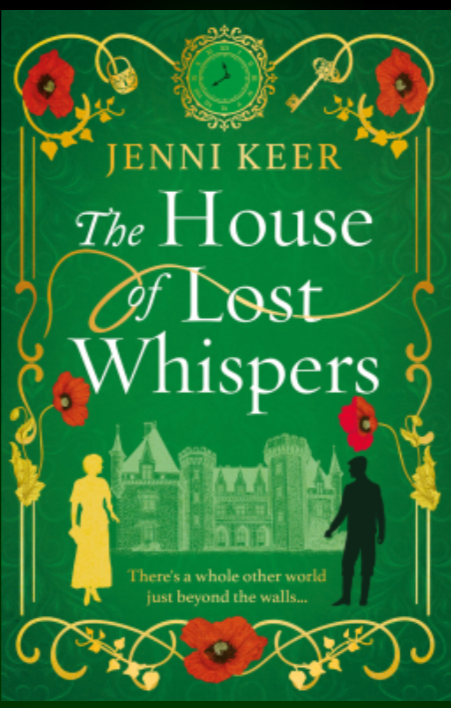
Book Review: THE HOUSE OF LOST WHISPERS


Title: The House of Lost Whispers

Author: Jenni Keer

Publisher: Boldwood Books

Pages: 378

My GoodReads Rating: ⭐⭐⭐


In 1912, thirteen-year-old Olivia Davenport is orphaned when her father, author Jasper Davenport, and mother Selina die on the maiden voyage of the Titanic. Olivia is invited to live with her father’s friend, Sir Hugo Fairchild and his wife Cynthia and their four sons, Clarence, Louis, Howard and Benji, at their lavish home, Merriford Manor.

The new house becomes the setting for Olivia’s overactive imagination, which she uses to deal with her grief, imagining that her parents aren’t dead but that they have lost their memories and will someday find their way to her.

Moving to an unused part of the mansion, Olivia has the initially unsettling experience of being able to hear and converse with a man called Seth who seems to be living on the other side of the wall in her tower bedroom. Both think the other is a ghost or a product of their overwrought imaginations.

Meanwhile, with the war breaking out in Europe, Sir Hugo and Lady Cynthia watch with increasing dismay and sorrow, as one by one, three of their sons go to war and never return.

It’s only after the war that Olivia realizes that Seth lives in another world where her parents are alive. And now she wants to get to that other world. But how can she find a way into his world?


I liked Olivia, her imagination, her contentment in her solitude, her longing for her parents, her faither, her larger than life outlook, her willingness to stand up for the bullied, Benji. These are the traits that get her in trouble, pushing some of the events forward, particularly in the fate of Seth, the undergardener.

I liked that Olivia wasn’t coy but knew exactly what she wants with regard to her future and the role she wanted to play in it. That she imagines a life for herself that isn’t limited to marriage and keeping house. But the scene in which she pleasures herself and explores her own sexual awakening was unreal and completely out of sync with the reality of an older teenager in the aftermath of World War I.

Among the others, the only one I liked was Lady Cynthia, who had the only developing character arc to speak of. From being standoffish and reserved, she learns to show affection, to get past her hangups. It’s a pity she ceased to play a role in Olivia’s life in the section called After the War.


I was a little uncomfortable with the scenes between Olivia, as a child, and Seth, because of the vast age difference between the two. While these scenes are driven by her imagination, there is no explanation for why Seth should turn out to be the one big love of her life.


It’s also more than a little strange that Olivia, no stranger to grief after the death of her parents and then the death of her fiancé soon after, should suddenly forget him, and begin to imagine that a guy she really doesn’t know all that well is the one great love of her life. What’s more, she is not even mildly curious about her parents who are alive and well in the other world.


The novel suffers because it tries to become too many things at once. Until the 23 percent mark, nothing happens. When things start happening, the novel starts shifting from one genre to another.


In the first part, Before the War, we get a hint of magical realism. This part of the novel is more than a little bulky. While the boys are away, and Olivia is basically entertaining herself, these scenes and chapters were boring and ordinary. Nothing of any significance happens during this period.


In Part II, During the War, we get historical fiction, and even war fiction, of sorts. This was the part I liked the most. The author brings out well the sense of bravado and adventure with which young men went out to the battlefront, unaware of the horrors that awaited them. The victorious nations found themselves just as broken as those they had defeated.

Through Clarence, the author gives us her views on the utter futility of war. Clarence says, “As a species, why are we so destructive?”

His mother tells him, “Poetry won’t sustain you in the trenches,” when poetry is sometimes the only thing that has the power to get us through the dark times.


In Part III, After the War, the brief hint of magical realism returns, then gives way to romance and a bit of a mystery, when Olivia tries to uncover why Seth’s old love suddenly disappeared.


This is where the problem arises, with the book trying to be several books at once. The back-of-the-book synopsis gives us a sense of this being a time-slip, parallel world issue, but in time, the romance between Olivia and two other characters takes precedence. I was disappointed by this turn.


Also, the parallel world bit doesn’t show up until quite deep into the book, when we have almost despaired of even seeing it. The explanation of how the parallel world came into being was interesting, but then it was sidelined and the story ended up being just another historical romance.


The idea of another world being created out of nothing, a world in which the Titanic did not crash, unleashing a whole different set of possibilities and history, was interesting, but wasn’t explored on a larger scale. All we are left with is a world in which Olivia’s parents did not die, but the World War still took place.


It would have been better if the author had found some way of getting Olivia to the other world where her parents lived. Instead, we get a muffling of the parallel world in favour of making do with the current one.


I also disagree with the notion that Olivia and Seth are the same in both worlds. A person’s nature and character are heavily influenced by their experiences. An Olivia that had not known grief and sorrow would grow up to be very different from one that had. It would have been better if the book had ended without the forced and rushed happy ending.


(I read this book on NetGalley. Thank you to the author, the publisher and NetGalley.) 
Sunday, December 15, 2024

Book Review: THE MURDERESS


Title: The Murderess

Author: Laurie Notaro

Publisher: Little A

Pages: 367

My GoodReads Rating: ⭐⭐⭐⭐


When two stinking trunks make their way to Union station, the porters have no idea what they contain. Only that they are bleeding and that the stench is overpowering. Mrs Ruth Judd claims that the trunks contain books belonging to her husband, Dr Judd. But she doesn’t have the key to the trunks. When the trunks are opened, they are found to contain the bodies of Agnes Anne LeRoi and Hedvig (Sammy) Samuelson. Now Ruth is on the run, declared a fugitive and wanted for the murders of the two women.

But who is Ruth? Married to a much older man, who she addresses as Doctor throughout their marriage, Ruth is swept into an affair with Jack Halloran, the neighbour of the Fords, in whose household she serves as a nanny. At the same time, she befriends Anne and Sammy, and the three women help each other through challenges.

But as the heat rises in Phoenix, Arizona, we see passions get inflamed, until the time comes when confrontation becomes inevitable, leaving the police to probe the question of how Ruth came to be responsible for the murders of two of her closest friends who she loved?


The greater part of the book is set around the late 1920s and 1930s. the past tense omniscient narrative is interspersed with newspaper stories and Ruth’s first person past tense account. Ruth’s account takes us back to 1923, when she is a young girl, slowly leading up to the present.


I was drawn to the book from the very first paragraph when the trunks are found. Soon we meet Ruth and know that she is responsible for this. The mystery lies in why she killed her two dearest friends. What follows is an intense story of passion and intrigue, as the police attempt to piece together the puzzle. This is the early 1930s, so a lot of the forensic technology and techniques available today are not in place.

The period comes with its own challenges, when tuberculosis could kill you. We learn about the challenges that Ruth faces, her tuberculosis, her husband’s opioid addiction, her loneliness, among other things. We learn also about the circumstances that people faced in that time, with the Depression looming large, the challenges faced by single women, the outlawing of homosexuality. In 1927, Ruth says, “people were still spending money like mad then,” reminding us that the Great Depression is still in the future.

The weather in Phoenix is as powerful as a character, influencing and driving Ruth on. The weather, combined with her loneliness, her struggle between choosing her own happiness with Jack and worrying about her lack of faithfulness to her husband (she is, after all, a pastor’s daughter), her dependence on substances to tackle the challenges she faces and her failing mental health (the illness runs in the family; her mother is eventually institutionalized too), all egg her on to make dubious choices.


The author pulls off the unimaginable, helping us to see the murderess as a flawed human. Despite the gory nature of the crime, the author treats it in a manner that is neither prurient nor base. I couldn’t help feeling an inexplicable feeling of compassion for Ruth as she slowly loses her mind. Ruth herself describes it as a ‘wire running through her.’

The crime may inspire revulsion, but Ruth’s story demands attention. Through flashbacks, we get to know how Ruth, Anne and Sammy become friends. We see the exact moment at which the situation changes for Ruth, hurtling her and the others to their inevitable fate.

Ultimately, the Murderess is one of us, like us. The book reminds us, as it did the staff at the matrons in the prison, how close we may be to having our own wires stretched too taut. It reminds us that there is a very thin line between mental health and mental illness. 


(I read this book on NetGalley. Thank you to the author, the publisher and NetGalley.) 


Friday, February 02, 2024

Book Review: THE DEVIL AND MRS DAVENPORT


Title: The Devil and Mrs Davenport 

Author: Paulette Kennedy

Publisher: Lake Union Publishing

Pages: 347

My GoodReads Rating: ⭐⭐⭐⭐


 (I read this book on NetGalley. Thank you to the author, the publisher and NetGalley.) 


Wednesday, June 22, 2022

Book Review: MURDER AT THE BRIGHTWELL (Amory Ames #1)


Title: Murder at the Brightwell (Amory Ames #1)
Author: Ashley Weaver
Publisher: Minotaur Books
Pages: 336
My GoodReads Rating: ⭐⭐⭐


The very first line, It is an impossibly great trial to be married to a man one loves and hates in equal proportions. With that almost Austenian beginning, the novel began.

While romance as a genre isn’t my preferred choice, I don’t mind it if it shows up in other genres, just as long as it stays unobtrusive. I had hopes it would be so, given that there was the word, Murder, in the title. But it wasn’t so.


Amory Ames’ marriage is strained within just five years. Husband Milo neglects her and prefers to spend all his time gambling in Monte Carlo. Amory regrets her whirlwind wedding with him.

When former fiancé and old friend Gilmore Trent invites her on a seaside holiday to the Brightwell hotel to warn his sister, Emmeline, to break off her engagement with her fiancé, Rupert Howe, an untrustworthy cad, Amory readily agrees.

At the hotel, Milo shows up, testing her friendship and Gil’s intentions towards her. When Rupert is found murdered and Gil arrested for the crime, Amory is determined to find the real killer and prove Gil’s innocence. Will she succeed? Or will the killer strike again?

Also, as Milo ingratiates himself to her, can she sort out her feelings towards Milo and Gil?


The story, set in Kent, England, in 1932, is written in the first person past tense point of view of Amory.

I liked the author’s descriptions. She describes a mismatched couple as something akin to a cinema star on the arm of a parish priest. Of another character, she says, The sort of person one liked at once, but for whom the fondness fades after a short time.

Amory’s back story, her issues with Milo were written well, but they took away the focus from the murder.

Amory was a good strong character. She is willing to stand up for herself, even if it means facing ridicule and going against the social mores of her times, and she dislikes the term, husbandly rights. She is quick on the uptake and has a delicious sense of repartee. Most of the time, she didn’t do stupid things to advance the plot.

The author makes a comment on the upper class who, no matter what the tragedy, still put social niceties above everything else.

In keeping with the traditions of the Grand Ole Dame of Mystery Fiction, the book is chock-filled with characters, but the air is more that of a cozy mystery than anything else.

The author or her editor would do well to pay more attention to her sentence construction, particularly sentences with ‘one’ as the subject.

I found the pace a little rushed towards the end, compared to the beginning and middle which devotes too much space to the stay at the hotel and the holidaying. I also had my doubts about the names, Milo and Amory, particularly in the England of the 1930s, when most classical literature of the time featured characters with traditional names.


(I read this book on NetGalley. Thank you to the author, the publisher and NetGalley.) 


Thursday, April 28, 2022

Book Review: PAPER HEARTS


Title: Paper Hearts

Author: Meg Wiviott

Publisher: Margaret K McElderry Books

Pages: 352

My GoodReads Rating: ⭐⭐⭐⭐


I’ve read numerous stories about the Holocaust and this one, based on a true story, was another grim reminder of that dark period. Here in India, the right-wing majoritarian government is following the Nazi rulebook. As a member of the minority, it is frightening to see the parallels.

I was drawn to the cover long before I read the synopsis. The curved line cutting through the P and H of the title, am embroidered seam on fabric, with the Star of David on the top corner.

This was my first experience of reading a novel set to verse. I was quite impressed with how the author countered the challenge of using few words and making them count.

The story is brought to us in the PoVs of Zlatka and Fania, two teenage girls at the Auschwitz concentration camp, in alternating chapters. Zlatka is the oldest of four children, who loses her family in the camps. The last time they are together is when they carry their worldly possessions to a grim future. We are reminded of the terror that the families face. The narrative in verse doesn’t give us details, but we know enough of this tumultuous and traumatic period in history to put them in.

Zlatka wants to show that she is stronger than they supposed a girl – a Jew – could be, should be. The transports, with their lack of toilets, filth and lack of privacy, and chunks of stale bread once a day are just the beginning of their troubles.  

Fania also loses her family in the camps. Before they are put on the transport, her father wonders How could such a society produce such masters (as Bach, Beethoven, Wagner and Goethe) and such monsters.

Fania’s parents think she looks Aryan, but it doesn’t save her from the worst.


Brief snatches of words gives us a glimpse of Jewish customs and rituals as on the night of the Passover. Past memories sneaking into the present.

The author picks the most frightening facts and distils them down. Images of Little children clung to coat hems in a place where fences too high to climb/ hummed with electricity.

Men made feral from war… I cringed,/ wondering,/ at a hollowness/ that made/ scrawny/ filthy/ sick/ girls look good enough to eat.


Within the narrative form, the author played around, using the form to show the Selection, the poor and frail on the left, the robust and strong on the right. The simple yet evocative titles section the scenes apart.


The very first verse gives us an idea of Zlatka’s changed reality as a Jew and her efforts to assert her identity while seeking not to draw attention. Eyes lowered/ not shamed/ footsteps steady/ not faster/ or slower/ than before.

We come to know of the steady isolation of Jews as the Nazis spread their tentacles. And we see the excesses of the camps, the shearing of hair, the tattooing of numbers, the tearing apart of families, through the eyes of the two girls.

It is a new order in which even criminals rank higher than Jews.


In the midst of it all, we see defiance, Laughter,/ not of the mad,/ but of the living. The girls become family to each other, offering consolation and comfort, facing the worst of Auschwitz. Guta, Giza, Bronia and others, all make a place for themselves in our hearts.


In a world in which the possession of a love letter is grounds for hanging, the girls know it would be suicidal to do what they did. And yet they barter precious bread to procure pencil and paper to make a small handmade paper heart for Fania’s birthday. The messages from the girls are a testament to their courage and a lesson to us on how life should be celebrated in the midst of our troubles.


Tuesday, January 11, 2022

Book Review: PARTING THE VEIL


Title: Parting the Veil

Author: Paulette Kennedy
Publisher: Lake Union Publishing
Pages: 367
My GoodReads Rating: ⭐⭐⭐⭐


Parting the Veil is a Gothic tale that is high on mystery and intrigue. The title refers to the parting of the veil that separates our world from that of the spirits.

In June 1899, American Eliza Sullivan arrives at Southampton, England, from New Orleans in the US with her half-sister, Lydia Tourant. She has let her past behind to start her new life in England, where she has inherited Sherbourne House from her deceased grandaunt.

According to the terms of the aunt’s will, Eliza must marry within three months of her arrival in England or else forfeit her claim to the house and estate.

Before long, Eliza falls in love with Lord Malcolm Winfield and his sprawling mansion, Havenwood Manor, not necessarily in that order, and rejects the suit of the richer Lord Charles Eastleigh, making herself an enemy in the process.

Smitten with Malcom and anxious to save him from being evicted from his home by Lord Eastleigh, Eliza elopes with Malcolm, even though her sister and nearly everyone in the village warn her of his bad reputation.

Once married, she wonders if she has made a mistake. Malcolm is a tender and fierce lover by night, but cold and distant during the day. Worse, the house appears haunted. There are ghostly sounds and shadows that frighten her. And Malcolm increasingly frightens her with his erratic moods. Lydia believes there is evil in that house.

Eliza wonders if she has married a man or a monster, and if there is any hope for her.


The book is written in the 3rd person past tense PoV of Eliza. The events in the present are interspersed with entries from the diary of Ada, Malcolm’s mother.

Right at the outset, we learn that Eliza does not live up to society’s expectations of her time. She is a far cry from the virtuous heroines we see in books set in that time. Eliza might easily horrify the people of England, and not only because she is American. Her habits, sexual desires etc are in contravention of what is seen as ‘proper’ in Victorian England. She is not averse to smoking and drinking and is inclined to be adventurous and curious on account of having read far too many novels.

Nor is she keen on motherhood. Eliza would rather have a career, and build her own stables.

In fact, one of her suitors, Lord Charles Eastleigh is shocked to learn that she is the horsey sort. He also thinks her cheek does not suit a lady.

Lydia is another strong character, persevering in loyalty to her lineage, even when the easy thing would be to claim white privilege and parentage alongside Eliza.

Despite their differences and their conflict ridden past, the sisters are immensely loyal to each other.

There are some French words strewn through the book, a reminder of their New Orleans upbringing. We also learn about feu follet, the legendary spirit of French and Louisiana folklore. There’s also a glimpse of the Creole culture of Haiti with the respect accorded to voodoo. The faith elements also come out strongly with Lydia telling Eliza, You’ll only be a prayer away.

What I liked most about this book was the care invested in using appropriate vocabulary. Writers of historical fiction often inadvertently end up using words that didn’t exist in the time and place they are writing in. In this book, I had no such complaint. The vocabulary used by the author creates an image of the period, with its chamber pots beneath beds.

The language is pitch perfect. Century-old words for everything. I kept the Kindle dictionary busy, with my attempt to figure out the meanings of so many words, now in disuse. Those four stars are for the vocabulary and the language.

I also appreciated the little details. Lydia pointing out the British pronunciation of lieutenant as being funny, for instance. 

The dark tones hint at a delicious Gothic tale and deliver too.

Havenwood Manor is like Wuthering Heights; it exerts its charm and mystique on us. With its spiral and grand staircases, a conservatory and a grand foyer among other things, it would be a treat to see the house on screen. The burned down dilapidated south wing might have its own tragic beauty. The author brings out well the sense of sadness and mystery surrounding the house.

The action scenes are handled well. The scene where Eliza finally steps on to the south wing had me reading with nervous excitement.

Trigger warning: for mental illness, suicide, incest, sexual abuse, domestic abuse etc. 

The pace of the book is rather laidback. This is fine in the first part of the book, but gets gradually annoying in the middle, when we wait for things to happen.

The book could, and should, have been shorter. It took a long time to get going.

After the wedding, I found the wild lovemaking tedious. It was annoying to be told repeatedly about the ache between her legs.

Till the 61 percent mark, I couldn’t see which way the story was headed. There was no clear antagonist in sight. The pace picked up in the last 100 pages. Unfortunately, I wasn’t impressed with the resolution. It seemed forced, and the explanation wasn’t explained properly.

There are a number of queer characters here. At the end of the book, one of the prominent, yet little known, characters says, This is one queer tale. I’d say, in more ways than one.


(I read this book on NetGalley. Thank you to the author, the publisher and NetGalley.) 

Tuesday, November 23, 2021

Book Review: WUNDERLAND


Title: Wunderland
Author: Jennifer Cody Epstein
Publisher: Crown Publishing Group
Pages: 373
My GoodReads Rating: ⭐⭐⭐⭐


We meet Ava Fischer in 1989. She receives a carton that has upended her world. The carton arrives from Bremen in Germany and contains a package with the ashes of her dead mother, Ilse, and a bunch of unsent letters, addressed by Ilse to a woman called Renate Bauer.

Through the letters, Ava (and we) begin to piece the history of Ilse and Renate together.

Growing up as teenagers in 1933, Ilse von Fischer and her best friend, Renate Bauer, are inseparable. They share all their secrets about teenage crushes and love each other like sisters. It is a friendship that means everything to them.
 
But a terrible history is unfolding in the country, and life, as they know it, is going to be horribly transformed. Businesses owned by Jews are being boycotted and shut and the Nazi insistence on the perfect Aryan model is making itself felt.
 
Ilse joins the BDM, a group of German young women being trained in the ideology. She sinks deeper in her belief in the Reich. The friendship is severed totally from her side.

When Renate and her family are castigated and reviled as Jews, Renate learns to embrace her newfound identity, placing the two former best friends on opposite sides of a great divide.

Meanwhile, Ilse has her own secrets. There are many things Ava doesn’t know,. Why she was abandoned in an orphanage as a child, where Ilse was during those years, her father’s identity being the biggest mystery. Will the letters and the confessions in them finally bring the truth home to Ava?


The book is written in the 3rd person present tense point of view of Renate and Ilse from 1933 onwards.
We have all read accounts of the Holocaust and World War II, but the unique viewpoint of this work of historical fiction made the horrors of the Holocaust vividly real. The two young girls, on the cusp of adolescence, find their friendship and their beliefs sorely tested, their lives torn apart on account of a cruel betrayal of one friend by the other.

The research that must have gone into the writing of this book is incredible. We see the birth of hate and war, and the geopolitical tumult that led to the creation of the Federal Republic of Germany and the German Democratic Republic.

The chapters relating to the destruction of Jewish businesses were painful reading. They bring alive the mob mindset of the rioters, how they see themselves as patriots who are wreaking destruction in support of a greater cause.

The writing was beautiful. What were their final thoughts as they lay bleeding in the snow or mud?... Or had they realised by then that it was all nothing more than a vicious trick; a foolish fable concocted by a madman whose only legacy would be the rest of the world’s loathing and revulsion?in

Here's another:

Not just the camaraderie she felt within the crowd’s collective fury, but a thrill of shouting…at her mother’s generation… wide wall of silence and complicity as the world erupted in napalm, flame, and corruption.

 
Living in an India whose very Indianness and democratic values are in question, we have deadly parallels to the Nazi regime. We have a megalomaniac in power who is promising to restore the country to its past (read: mythological) glory, but is pushing us back in time. The regime is succeeding in its aim to polarise the country and demonise its minorities. Not unlike Hitler and what he did with the Jews.

In the characters of the Bauers and the von Fischers, I see how my own compatriots have been polarised, as if a line had been drawn separating the two.

Renate’s parents, a doctor and a professor, hate Hitler but Ilse’s parents believe in him, another similarity with the India of today. Ilse herself believes that being part of the BDM is her chance to be part of something bigger.

This was a beautiful novel, one that particularly resonated with me because of the times we live in. 

LinkWithin

Related Posts Plugin for WordPress, Blogger...