Showing posts with label Memoir. Show all posts

Monday, September 01, 2025

Book Review: THE HOUSEKEEPER'S SECRET


Title: The Housekeeper’s Secret

Author: Sandra Schnakenburg

Publisher: She Writes Press

Pages: 290

My GoodReads Rating:⭐⭐⭐


At first the book reminded me of The Help by Kathryn Stockett, where a young white woman, Skeeter Phelan, interviews black women, such as Aibileen, Minny and ten others, who work as maids for white families, and writes down their true stories in a book later published as The Help. As I read on, I realized that the similarity, a member of the family writing about the person who worked for them, was the only similarity. Lee Metoyer, who works as a housekeeper to the Krilich family, is white and this is a different time and a different part of the US.

In 1965, Lee joined the Krilich family as a housekeeper. When she joined, Lilian, the author’s mother, had only one instruction for her children, five girls Roseann, Debbie, Robin, Barb, Sandra, and a boy, Rob. They were not to ask Lee any personal questions about her family or her past.

Lee remained part of the household until 1994, becoming a friend to Lilian, and a second mother to the children.

In 1994, Lee tells Sandra to write a book on her, the book she herself often said she’d write someday but wasn’t able to. Sandra makes a solemn promise to Lee and decides to start interviewing Lee and getting to know her story the very next day. Unfortunately, Lee passes away that night.

In the absence of the primary source, Sandra is unable to follow through with her promise, and it is only decades later that she is able to piece Lee’s story together by interviewing others and through research.


The Housekeeper’s Secret is the book that Sandra promised to write. While Lee’s secret is compelling enough, the book falls short as it ends up being about so many things other than Lee.

We learn that Sandra’s father was unreasonable and autocratic, planning a family vacation to Disneyland at just 30 minutes’ notice, another trip to Puerto Rico at just 4 days’ notice and bringing back three baby crocodiles as pets. I was amazed to read about the expanse and luxury of the author’s childhood home, with its laundry chutes, among other things.


The story is written in four parts, divided into Summer, Fall, Winter and Spring. When Summer begins, the children are all young. When the Fall section begins, the timeline has moved ahead by seven years. Lilian gets to know of her husband’s infidelity (he has a second family) and decides to ask for a divorce. But then Sandra, in middle school, meets with a bicycle accident, and suffers traumatic brain injury. She has to relearn to speak, read and write, and rebuild her life from scratch. This section ends when Sandra turns 23, when she goes to college and earns a degree without her father’s financial or emotional support. This is when her parents finally get divorced. The family home is sold, and Lee and Lilian move to a smaller home.

By the time the Winter section starts, 59 percent of the book is over. By now, Sandra is married, and has a job, and she gets busy with her family. She forgets the promise she made to Lee. It is only after her mother’s death in 2008 that the siblings find an urn containing Lee’s ashes in the house, sparking Sandra’s journey anew. This is the 64 percent mark.

The secret is finally revealed at the 74 percent mark. At this point, the prose becomes mellow, more emotional.

I couldn’t sympathise as much as I wanted to with Lee’s past. I felt emotionally distant from her story.

Lee must have extraordinary resilience, I can imagine, but there should have been more commentary about it. The story would have worked better if it had been all about Lee, whether as fiction or non-fiction. As it was, so much of the story was about Sandra’s childhood and family, her college, her husband etc, with a mere 36 percent devoted to the promise in the title.

Of course, it’s not the author’s fault. Lee never revealed her secret herself. Had she done so, we would have learned about how she renewed herself, how she learned to tamp down the parts that brought her pain.

All the questions that Sandy has about Lee, how she is the only one who knows how to help traumatic brain injury, how she lost her teeth and needs dentures, how she knows how to deal with abusive men, her strange walk, her dread of bathtubs, her craze for baseball, are all answered through conjecture.

I have one minor quibble too. Frustrated by an inability to get any answers on the Internet, Sandra’s search gets a boost when a friend, Vickie, gives her valuable information about Lee’s siblings, down to their ages and dates of birth. The author never reveals how Vickie came by this information.

The ending was nice with the Krilich siblings getting a chance to meet Lee's children. 


(I read this book on NetGalley. Thank you to the author, the publisher and NetGalley.)


Wednesday, February 28, 2024

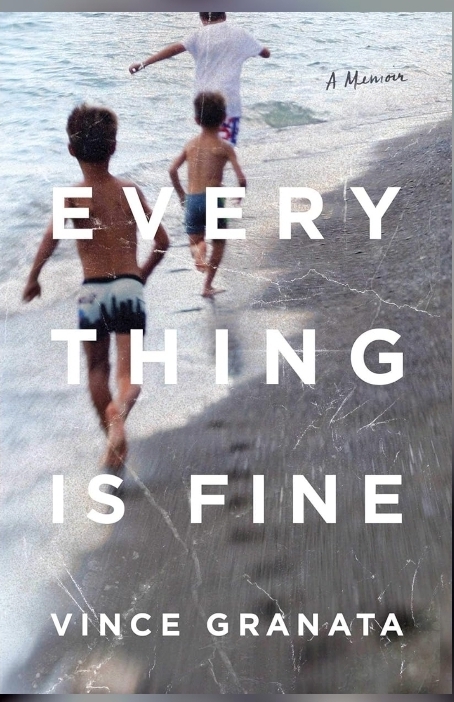
Book Review: EVERYTHING IS FINE


Title: Everything Is Fine  

Author: Vince Granata

Publisher: Atria Books

Pages: 303

My GoodReads Rating: ⭐


Vince Granata was an only child until age 4 when the miracle of IVF gave him three siblings. Triplets Christopher, Timothy and Elizabeth looked up to him, had raucous playtime sessions with him and built many lovely memories together.


Twenty years later, Timothy became schizophrenic, and from there stemmed the biggest tragedy of their lives as a family when Tim stabbed their mother Claudia to death. While Christopher and Elizabeth cannot imagine someone they shared a womb with acting out as he did, their father continues to stand by Tim and his need for medical aid, while Vince takes it upon himself to understand schizophrenia in an attempt to make sense of their lives and so as not to lose sight of his own love for Tim.


The writing is moving and kind, as Vince throws light on the family dynamics, the love that bound them together and the illness that stabbed the core of the family. As Vince shares the happy memories of his family, we are given a glimpse into how Tim’s mind betrayed him, twisting those memories around.


At every step, Vince has taken his role seriously: as his parents’ deputy and as chronicler of the tragedy that has befallen them. Even as a grown man, he sees himself as his mother’s deputy, wanting to forgive and understand his brother.


Vince dips into his memories to remind himself of all that was good about Tim and how schizophrenia took it away.


The author gives us an understanding of schizophrenia, how the illness sneaks up not only on the affected person, but also on the family. The book fills you with compassion for those suffering from mental illness, which we all fear and look upon with distaste.


The book is both deeply personal and well researched. The author drowned himself in books and studies about schizophrenia. He tells us about the laws governing the treatment of schizophrenics in the US, about his fears that he failed his brother.


The research is not limited to reading alone. The author has spent time talking to family members of those affected by schizophrenia, doctors and social workers and patients living with schizophrenia.


To those of us who use the word, schizophrenia, as an insult or a slur, this book is an eye-opener. The author calls for more schizophrenia stories to widen our awareness of the illness.


The name of the book comes from the phrase, Everything is Fine, which Vince’s mom used to use to preface her texts to him, when giving him updates about Tim. Everything is Fine was a way of de-escalating the situation, preventing the buildup of stress, until the time when the word, but, needed to be appended to the phrase.


(I read this book on NetGalley. Thank you to the author, the publisher and NetGalley.) 


Friday, November 12, 2021

Book Review: THE UPSTAIRS WIFE: AN INTIMATE HISTORY OF PAKISTAN


Title: The Upstairs Wife: An Intimate History of Pakistan

Author: Rafia Zakaria

Publisher: Beacon Press

Pages: 265

My GoodReads Rating: ⭐⭐⭐⭐


This book, with a tagline, An Intimate History of Pakistan, aims to catch one family, the Zakarias, at a moment that is both private and public. It is a moment that pertains to them as a nation, as well as at a deeply personal level.

On December 27, 2007, Benazir Bhutto was assassinated, plunging Pakistan into turmoil and aggravating the chaos in the life of one family. On the same day, the author’s uncle, husband of her father’s sister, Aunt Amina, was rushed into surgery after suffering a sudden stroke. Uncle Sohail survives and Benazir dies. These two events alter the personal history of the Zakarias and the history of the nation respectively.

The assassination of Benazir is the opportunity for the hardliners in Pakistan to take charge, impacting the state of women’s rights in that country.

 But this is not the first time, the personal and the public have come together for the Zakarias. Much earlier in April 1986, Benazir Bhutto had returned to Karachi after a 7-year self-imposed exile, following the imposition of martial law by General Zia-Ul-Haq and the execution of her father, Zulfikar Ali Bhutto.

 Parallelly, one morning in December 1986, Aunt Amina had rushed into the Zakaria home, her life in disarray, with the news that Sohail, frustrated with his wife’s inability to conceive, planned to take on a second wife, one of his colleagues, with whom he had fallen in love. It is the most ordinary of days that enclose tragedy within their sealed lips. Ironically, the second wife isn’t able to conceive either.

The author, a dangler on the edges of adult conversations, as all writers must be, guesses rightly that married women do not spend the night at their maternal home.
 
Sohail adds another floor to the house, moving his first wife upstairs, out of sight, where she becomes a pariah, spying on the happenings below. Aunt Amina is the Upstairs Wife. I felt her pain and sadness. In many ways, it is the pain of the deserving being cheated of their rights.

As one person dies and another survives, author Rafia wonders about the nature of prayer, how their prayers were granted but their fervent prayers, decades ago, that her aunt may conceive were denied.

As the narrative interweaves the past and the present together, we read about the volatile events in Pakistani history as well as the less violent but still momentous events in Aunt Amina’s life. As history unfolds through the eyes of the author as a child, she comes of age, having deeply absorbed and understood the weaknesses, hopes and errors of a fledgling nation.

The family history is intertwined with social and political history. We see the births of the key members of the Zakaria family, from Abdulla, Rafia’s father, to Amina, her aunt, and the family’s immigration to the newly-born Pakistan. Slowly they begin to settle down, trying to live their lives against the backdrop of larger-than-life events such as the division of Pakistan’s West and East, and the wars against India.

Their hope of a better life among Muslims is scuttled as India-born immigrants are viewed with suspicion and hostility. Later as the country vigorously adopts Sharia law and gets increasingly Islamized, we read about how women often get short shrift, how the First Lady was instrumental in forging a law that a Pakistani Muslim man not be allowed to take a second wife without the permission of the first wife.

The events in the book happen in Karachi, in Pakistan, but they might as well have happened in India. The very first sentence tells us about the tendency to leave barred windows ajar, the sounds of children playing, hawkers advertising their wares, car horns blaring, exhaust fumes blending with cooking smells painting a picture of small town and big city life that would be perfectly at home anywhere in India. There were so many cultural resonances despite the different faiths and cultures.

I liked how in their innocence the kids agree that they never liked Uncle Sohail before, but now they hate him.
 

The writing is beautiful, conjuring up a world of images that is at once exotic and familiar. My mother’s wide smiling mouth gathered into an uncertain tightness, as if pulled by a drawstring.

A lane of houses all mismatched in height is described as The awkwardness of a group of mismatched cousins pushed together in a hurried family portrait. 

 Two of the four stars that I have awarded are for the beautiful prose.

But the lack of a cohesiveness that binds the parallel strains gets in the way of us feeling totally invested. The history of the nation and the family are presented simultaneously, but the connection between them is tenuous at best, and sometimes there is no connection at all.


(I read this book on Edelweiss. Thank you to the author, the publisher and Edelweiss.) 


Tuesday, September 22, 2020

Book Review: THE BIGAMIST


Title: The Bigamist: The True Story of a Husband's Ultimate Betrayal
Author: Mary Turner Thomson
Publisher: Amazon Publishing UK
Pages: 240
My GoodReads Rating: 


This is the third edition of this true story. In the earlier editions, all the names were changed except for those of the author and Will Jordan. In this edition, the real names of the children have been used on their insistence.


The book begins in April 2006, when an unknown caller tells Mary that she has been married to Mary’s husband, and the father of her two younger children, for the last 12 years and that they have 5 children together. This shocking revelation is only the first. Recovering from her shock, Mary embarks on her own investigation to find out the truth behind Will’s deception.

With this introduction, Mary takes us back in time, to their courtship and their wedding and their life together. We start in November 2000 and slowly come to April 2006, where I, for one, felt relieved at the thought that the truth would set her free. But the truth is far more complicated than Mary could have imagined.


It was November 2000 when Will Jordan first reached out to Mary Turner Thomson through a dating site. Mary was then a divorced single mother, with a good job, and her own home. She had the support of her mother, and was doing a great job of raising her little baby girl.

Will and Mary met in December 2000. Slowly they fell in love, and Will informed Mary about his work. He told her that he was a CIA operative, as an explanation for his sudden disappearances and long absences during which time he left her with no clues about what he was about. He even failed to show up to his own wedding.

During those initial years, he told her that he was infertile, as a result of a side effect of mumps which he suffered as a child. He was madly thrilled when Mary conceived their first child, a girl they named Eilidh.

In May 2002, she was forced to incur debt, first to pay for Will’s mother’s hospitalisation bills in the US, and then to buy a car for him to drive members of the CIA around. This was because he had given up active service in the CIA at her behest, but the CIA would not let him go without a fight. So he had to do these mean jobs or else they would not release his salary. He never gets paid his dues, and Mary’s finances get strained further, as Will makes frequent calls pleading for money to pay the CIA.

In all, he dupes her of over £200,000 pounds and leaves her feeling desperate and broken.


As readers, we feel an impotent sense of annoyance at Mary for allowing herself to be taken in. We feel that way because we have no idea what it must be like to be victimised by a sociopath. I don’t think Mary was more gullible than we would have been in her place.

She deserves to be commended for her courage in admitting her foolishness and making it her mission to expose his lies and save other women rather than choosing to keep quiet in the interest of salvaging her pride.

Mary comes across as sensible and good-hearted, if a little too trusting and willing to give a loved one the benefit of the doubt. Even though his secretiveness and his behaviour upset her, she didn’t give up on him. And it was this kind nature that Will took advantage of.

Mary stuck with him, incurring more debt, because the truth was hard to stomach, and reality nothing but outright misery. When she was completely broke, and no longer had any money to give him, she felt a strange sense of relief.

The fact that Will seemed to have so much information about things that didn’t even show up in the news until days later helped him gain Mary’s trust.

The author gives us a lot of detailed information to bolster her story. Through her narrative, we get a sense of an intelligent woman who got conned by a man completely lacking in scruples.

There were many times when I was furious with Will for the way he treated Mary. He not only didn’t show up for his own wedding the first time the ceremony was planned, he didn’t turn up for the birth of his two children either. If only her intuition had guided her to take his no-show at the wedding as a sign and call it off, she would have been spared all the misery.

Through it all, I was pleased to see that Mary’s commitment to her three children never wavered. Nor did her family, especially her mother, ever stop offering her support and strength.

Not only was he not infertile, Mary learns that Will has had more than ten children by different women. And even this number might be under-reported.

Learning of the deception that she has suffered, Mary is determined to get to the bottom of it. And she does. 

The book takes us through Mary’s investigation as she diligently follows up clues, and talks to people to piece together the story of the man she thought loved her. A man who had been conning women and spinning tangled webs of lies for over 27 years. A man whose deception began in the US and continued in the UK.

I can only hope and pray that Mary gets the justice she deserves and that Will pays for the lives he has destroyed.


(I read this book through NetGalley. Thank you, NetGalley, the author and the publisher.)

Friday, September 28, 2018

Book Review: Bird by Bird and a BIG REVEAL

Title: Bird by Bird: Some Instructions on Writing and Life
Author: Anne Lamott
Publisher: Anchor
Pages: 237
My GoodReads Rating: ⭐⭐⭐⭐


There were so many things I could relate to in Bird by Bird: Some Instructions on Writing and Life by Anne Lamott: the thrill of seeing one’s name in print, of claiming ownership through a byline. Of the thrill of writing on days when it seems effortless, and the agony of days when the scratched words make you want to tear your hair out.

She doesn’t tell you that it’s easy to be a writer or even that the rewards can make up for the drudgery. The simple act of sitting down to write and the 1001 thoughts that conspire to get in the way.

The book, she tells us, consists of almost everything that she talks about in her writing classes. The whole is tied together with a thread of quiet humour that makes you chuckle out loud. The whole thing is peppered with charming personal stories and anecdotes from films and books, as well as real-life experiences.

In Part One – Writing, she tells us about the importance of shitty first drafts and the problem of seeking perfectionism. How when you write shitty first drafts, you find yourself honing one thing, and then when you zoom out, slowly you begin to notice other things around it. How in the writing of one thing, you will remember other things that weren’t in your mind, when you started.

She describes the act of character and plot development, how they must both drive the story forward. You, as the writer, must watch like a mute spectator as your characters come alive. Here she passes on a formula, originally defined by writer Alice Adams, who talks of ABDCE, namely, Action, Background, Development, Climax, Ending. She also touches upon Dialogue, which I personally find the most challenging.

In Part Two – The Writing Frame of Mind, she stays that there must be something at the centre of your story, something about which you care passionately, which must shine through. Our deepest beliefs must drive our writing.

In a delightful reference to an old Mel Brooks film, she reminds us to “Listen to your broccoli, and your broccoli will tell you how to eat it.” It is a reminder to us to shut down our rational mind, and listen to our intuition which will lead us on in a far truer and more satisfying manner.

In Part Three – Help Along the Way, we learn about the importance of writing down every little tidbit we consider important on index cards. I’ve learned this the hard way, and vouch for this bit of advice. Everything I have written down, I still have; everything I have trusted to memory, I have forgotten.

She also tells us about the importance of writing groups, and of being able to rely on a few individuals who we can trust with our shitty first drafts, and of how to counter writer’s block.

In Part Four – Publication – and Other Reasons to Write, she tells us about Finding Your Voice, Giving, Publication, how it is not the end, but a beginning, a starting again on the blank page.

And then in Part Five – The Last Class, she tells us that as writers, we must keep writing.

When writers make us shake our heads with the exactness of their prose and their truths, and even make us laugh about ourselves or life, our buoyancy is restored. We are given a shot at dancing with, or at least clapping along with, the absurdity of life, instead of being squashed by it over and over again. It’s like singing on a boat during a terrible storm at sea. You can’t stop the raging storm, but singing can change the hearts and spirits of the people who are together on that ship.


There’s so much that you would like to quote:

For some of us, books are as important as almost anything else on earth.

Writing is, for some of us, the latch that keeps the door of the pen closed, keeps those crazy ravenous dogs contained.

A big heart is both a clunky and a delicate thing; it doesn’t protect itself and it doesn’t hide. It stands out, like a baby’s fontanel, where you can see the soul pulse through.


The style of this book has so many memoir-like elements mixed within the book on writing that by the end of it, I thought that Sam, her little son, was a pretty cool little guy, and was saddened at the death of Pam, her closest friend.

So much of the advice while being pertinent to writing is just as relevant to life. As when she tells us about how her dying friend, Pam, taught her how to live better, told her that she didn’t have time enough to waste on unnecessary things. Her response, “Okay, hmmm, let’s see. Dying tomorrow. What should I do today?” can help us not only write better, but also live better.

And how on days when the muse just won’t oblige, you write unrelated stuff, stuff from your old memories, while you wait for my unconscious to open a door and beckon. That’s when the party starts, as any writer who has experienced the beckoning can vouch for.

I want to end this review with one of my favourite quotes from the book: This is what separates artists from ordinary people: the belief, deep in our hearts, that if we build our castles well enough, somehow the ocean won’t wash them away.


It is a belief that has consumed me too.

And that is why the review of this delightful book is as good a time and place as any to make my big announcement.

With the last i being dotted and the last t crossed, I am now working towards self-publishing my first Book. It's a book that has grown out of this blog. A dream I’ve had for as long as I can remember, and it’s taken a long, long time to mature.

I hope for your prayers as I take my fledgling steps towards achieving my dream.

LinkWithin

Related Posts Plugin for WordPress, Blogger...