Showing posts with label Series. Show all posts

Sunday, April 27, 2025

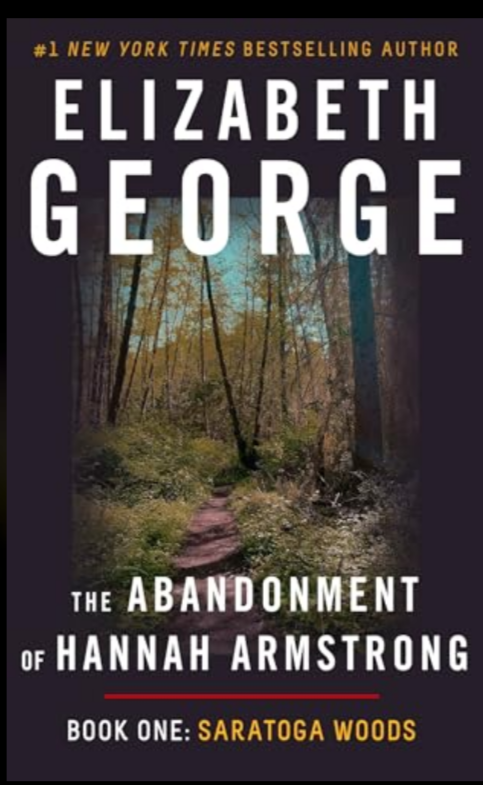
Book Review: THE ABANDONMENT OF HANNAH ARMSTRONG (BOOK ONE: SARATOGA WOODS)


Title: The Abandonment of Hannah Armstrong (Book One: Saratoga Woods)

Author: Elizabeth George

Publisher: Elizabeth George

Pages: 407

My GoodReads Rating: ⭐⭐⭐⭐


I signed up to read Saratoga Woods because I’m a big fan of Elizabeth George and enjoy reading her Inspector Lynley series. But I couldn’t quite get into this one at the beginning. It was a slow start.


When 14-year-old Hannah Armstrong’s stepfather, Jeff Corrie, turns out to be a criminal, a fact she learns about because she has the power to hear people’s thoughts, her mother, Laurel Armstrong, uproots them from California to Whidbey Island, near Seattle. With a new name, the young girl, now Becca King, is sent to live with her mom’s old friend, Carol Quinn, who has promised to shelter her.

When Becca reaches Whidbey Island, she learns that Carol has died of a heart attack. With Laurel unavailable on the burner phone, Becca has nowhere to go in a strange town.

When Derric, a new friend, has a nasty fall on a bike trail, he goes into a coma. The town sheriff, Dave Mathieson, who is also Derric’s adoptive father, is sure that the young girl who called 911, the owner of the burner phone, has something to do with the accident. Will Becca be able to stay out of trouble, or will it come looking for her?

It is up to Becca to sort through the confusion in her own mind, and stay afloat and out of trouble until her mom returns for her, while solving the mystery of who might have wanted to hurt Derric.


This is a coming-of-age story with fantasy elements. Besides Becca, there is another character who might have a supernatural power. But where the other person has the gift under control, Becca is still figuring out her way around it.

The story is written in the 3rd person omniscient PoV. The writing is more tell than show, which is the author’s style, but I still enjoyed it.

Here’s a sample of her metaphors:

The idea of missing someone was like the swooping of a bird too close to her face.

She came into the room like a tractor rolling over a field.

Debbie gave him the kind of look a teacher gives to a kid when she suspects there are lice crawling in his hair.


Elizabeth does a great job recreating Whidbey Island in our minds, a place where everyone knows everyone else.


In her most vulnerable state, Becca encounters a slew of characters. There’s Debbie Grieder, who offers her shelter in her motel, Diana Kinsale who is sympathetic towards her, Seth Darrow, a school dropout and musician who helps her, and Derric Mathieson, a boy from Uganda who she finds fascinating. Then there’s Jenn McDaniels who can’t stand Becca, Hayley Cartwright, Seth’s former girlfriend who he suspects broke up with him on account of Derric, Debbie’s grandchildren, Josh and Chloe, Seth’s grandfather, Ralph, and his dog, Gus, and Derric’s parents.


As befitting a series, Becca has individual subplots with Seth, Debbie, Diana, Derrick, Josh, Chloe and Jenn. Seth has subplots with Hayley, her parents, grandfather Ralph, dog Gus and Derric.


The stories of these characters converge in multiple ways. For the greater part, it all seems like delicate wisps of unconnected threads. It’s only at the end that they come together.

The first description we get for Becca comes from the most minor of minor characters and it’s not flattering, but by then, we’ve bonded so well with her, we don’t care. We feel sorry for Becca, stranded in a strange place with no safety net.


While I loved the book, there were some things that rankled. There are multiple characters whose names begin with the letter D. There’s Debbie Grieder, Diana Kinsale, Seth Darrow and Derric Mathieson. Why did the author flout the fundamental rule of not naming characters after the same letter?

I couldn’t understand the significance of the Paul Revere poem that Laurel keeps repeating, when she doesn’t want her daughter to listen to her thoughts. Perhaps its meaning will be clearer in the subsequent books.

The mystery of who pushed Derric hinges on a footprint but it’s odd that the police don’t ever latch on to that clue. The mystery itself is a slow burn; who hurt Derric takes a backseat to who was the girl who made the call to the police station.


While the main plot of this book ends on a successful note, the overarching story in the series shows up on the very last page, making the way for Book 2. I look forward to the next one in the series.


(I read this book on NetGalley. Thank you to the author, the publisher and NetGalley.) 


Monday, December 14, 2020

Book Review: MURDER AMONG FRIENDS


Title: Murder Among Friends
Author: Janice Foster
Publisher: Joffe Books
Pages: 245
My GoodReads Rating: 


DI Stephanie Warwick is called to the scene of a murder. The murder has been called in by a 45-year-old former teacher turned special constable Jane Bell, out on her very first shift.

The victim turns out to be Mark Ripley, who used to run a group that claimed to teach any man to attract a woman into sleeping with him. His methods, he used to claim, were loosely based on the wildly popular book, The Game, by Neil Strauss.

Warwick finds Jane extremely annoying. She thinks the older woman is too self-assured and resents her for not heeding her authority.

At first Jane is keen on learning more about the case. On another of her shifts, she encounters Ryan, a student who is also attacked on the head, and she wonders if the cases are related. Then she herself is attacked and the case becomes personal. She makes her own enquiries and keeps her findings to herself, knowing that Warwick will not appreciate her snooping.

When Ryan’s friend, Kylie Bright, tells Jane about a man who stalked her at a restaurant, Jane wonders if he has something to do with the case. Then Kylie is murdered, and Warwick gets Jane suspended.

Was the murderer part of Mark’s group or is the killing a random one? And can Warwick or Jane solve the mystery before the killer strikes again?


The book is written in the 3rd person past tense limited point of view of Warwick and Bell in alternate chapters.

It touches upon the subject of misogyny, where some men seem to think that women have no agency, and that it is up to the man to take whatever he wants regardless of what the woman might think. It also indicates an unwillingness to face rejection.


It’s the classic pairing that works so spectacularly in books and films. Experienced person versus the rookie, but together they make a good team. 

Unfortunately, Warwick and Bell have no intensity or chemistry of any kind. Neither of them can stand the other for most of the book. So I can’t imagine how book 2 will go, considering this is the first in the series.

Warwick doesn’t endear herself to us. She has an equally clinically sterile working relationship with DS Elias Harper, her subordinate.

Of course, Warwick has her own demons. An abusive ex-boyfriend, Cal, who still taunts her in her dreams and occasionally in waking moments too.

Jane, on the other hand, is a widowed English language tutor, whose loving and supportive circle of friends more than make up for her two kids who remain unavailable to her throughout the book.


The return from the flashback to the present was not done smoothly. There were also some proofing errors. “On the small size,” instead of side. Harper was called Hunter a few times.

There are a lot of architectural bits of information about the city, but they don’t give you the impression of the city as a whole. The narrative was all tell, and no show.

Warwick and Jane seemed to arrive at the same conclusions through different means, and in Jane’s case, it really was serendipitous.

The dialogue was clunky and boring, with characters sharing the same information with different sets of people.

The action didn’t feel urgent at all. In fact, all the pressures that Warwick faced were self-generated. There was no pressure from the top, even after a second murder took place. Her backstory with Cal was a plot that might have been interesting enough to read as the main plot rather than being hurried through as the flashback.

I picked up this book because I found the premise interesting, but the execution left a lot to be desired. The wrap-up was hurried and inconclusive. The book title was most inappropriate, and the picture on the book cover irrelevant. 


(I read this book through NetGalley. Thank you, NetGalley, the author and the publisher.)

Wednesday, November 06, 2019

Book Review: ELLIE JORDAN, GHOST TRAPPER

Title: Ellie Jordan, Ghost Trapper (Ellie Jordan, Ghost Trapper #1)
Author: JL Bryan
Publisher: Self-published
Pages: 220
My GoodReads Rating: ⭐⭐


Ellie Jordan, the senior investigator of Eckhart Investigations, is, at a mere 26 years of age, a veteran when it comes to fighting ghosts and clearing haunted houses. She has a sidekick, a trust fund girl trained in filmmaking called Stacey Ray Tolbert, who helps her to solve her cases.

The two women are called to the home of Anna and Dale Treadwell. Anna and the couple’s 10-year-old daughter Lexa are tormented by a ghost, Mercy Cutledge, who wants them to leave the huge yet rundown mansion they have bought in the hope of converting it into a small hotel. Dale is in denial, and refuses to believe that the ghost is real.

Mercy, it turns out, brutally murdered her former employer, Capt Augustus Marsh, and was later committed to an asylum. When the asylum was closed down, she returned to the house and hanged herself.

Calvin Eckhart, the owner of the firm, wants Ellie to work with Jacob Weiss, a young accountant who is a psychic and needs to practise his psychic calling as part of his therapy. This is something that Ellie isn’t too happy about at the beginning, but then Jacob turns out to be an asset to the team.

Ellie’s and Stacey’s attempts to get rid of Mercy turn on them. Even as they struggle to get rid of her, a deeper, more malevolent evil awaits them in the depths of the house. Will they die in their attempts to rid the house of this evil presence?


The book is written in the first person past tense point of view of Ellie. The story was well written and I enjoyed it. It was good to see things from Ellie’s perspective and get to know of her fun working relationship with Stacey. The description of the house and the asylum were very evocative, inviting me to imagine the scenes. The danger at the asylum, in particular, were scarily real. The final confrontation and the resolution were well drawn out. The story wasn’t left hanging, to be continued in Part 2.

Ellie has a great sense of humour. She says, If we could learn to harness and domesticate ghosts, we could save a ton on air conditioning, especially down here in the Deep South.

Elsewhere she says, The stairs below me creaked and groaned under my weight – which isn’t that much, people.

In another instance, Ellie tells Stacey to play music to temporarily stun the ghosts. Stacey clicks her iPod on but Taylor Swift’s “We are never ever getting back together,” plays instead. It surprises the ghosts for a moment but then they get over it. Ellie says, The ghosts recovered and began to advance on us again from both stairways, clearly ignoring Taylor Swift’s firm rejection of pursuing any further relationship.

While I liked the characters of Ellie and Stacey, the book became even more interesting once the psychic element was introduced. Of course, while Ellie’s back story was believable and explained the compulsions that forced her to do such work, I could not understand why Stacey would opt to do such work just because nobody else would. After all, she is a trust fund kid. Paying the bills isn’t a pressing need for her. And her romantic interest Jacob isn’t even introduced when she makes up her mind to continue ghost trapping for a living.

Even though the book concerns the paranormal and the field of parapsychology, Ellie prides herself on being scientific in her approach. She has all kinds of impressive machines to help her corner and nab spirits and spy them. Bonus points to the author for the imagination required to ‘invent’ such machines.

One grouse I had related to Lexa’s parents. How could they continue to make her sleep alone, when the house was haunted, and the ghost repeatedly pushed the little girl’s locked door open to scare the family into leaving? Why couldn’t they invite her to sleep with them? Isn’t there safety in numbers? Especially when several characters mention the horror film trope of characters separating just before they die.

This was the first book in the Ellie Jordan series and I enjoyed it. I’m on my way to the second now.

Thursday, January 10, 2019

Book Review: Escaped: A Thriller of Partho, the Unconventional Investigator

Title: Escaped: A Thriller of Partho, the Unconventional Investigator
Author: Rajib Mukherjee
Publisher: Kindle edition
Pages: 150
My GoodReads Rating: ⭐⭐⭐⭐


Partho, the intrepid inventor, his trusted sidekick and brother-in-law Dev, and wife Ria are back. This time for a scientific conference that takes Partho to Philadelphia, where the trio have decided to have an extended holiday. At Philadelphia, they meet Dr David Hall, Partho’s friend and mentor. While on a sightseeing trip with Charlie, David’s nephew, they encounter a disheveled man being chased by gangsters.

Later, Peter, a cop and David’s son-in-law, seeks Partho’s help to solve a mystery involving trouble. Flinn, a death row inmate accused of treason, double homicide and hate crimes, has escaped from prison.  

Hitting upon an important lead, Partho signs the three of them on a bus tour. Soon it becomes clear that not everyone on the tour is enjoying a leisure trip. Partho also becomes aware of a countdown to a huge explosion. Their efforts to prevent the explosion fail and Partho goes missing.

Who is responsible for playing with the lives of thousands of innocents? And what do they hope to gain from it? And will Partho return safely?


As in Book 1, this book too is written from the first person past tense point of view of Dev, the Watson to Partho’s Sherlock.

What I liked most about this book was the sense of familiarity it evoked, after I had thoroughly enjoyed the first one. It felt as if I was meeting a couple of eccentric but still lovable friends, who had plenty of foibles.

The element of danger is notched up in this book and the potential negative repercussions of failure are much higher. The plot itself is far more complicated than it was in the first book, and the pace far headier. The large number of characters added to the challenge of keeping track of who is who, but the effort was rewarded.


In the second book, the author gives us a little bit of the back story of Partho, making it a little easier for us to understand him.

The best part of the Partho series is undoubtedly Partho himself. He may seem a trifle mollycoddled with Ria fussing constantly over him, but he still comes across as a good guy, a chap you want on your side. You never know which of his inventions might serve as a lifesaver. The beauty of Partho’s inventions lies in their sheer ingenuity. I also appreciated his willingness to step up and risk his life for a total stranger.

The book is written with humour and enthusiasm. The author tells us of Partho, Viruses often announced their arrival in the neighborhood through him.

The only thing that gave me pause was the number of grammatical errors in this book. The use of different tenses in the same sentence, incorrect usage of words etc. it took away from the pleasure this book gave. I hope the author rectifies this soon.

Also, I missed the philosophical tidbits and the humour that Partho had to share in the previous book. Here he was a little too serious.

I look forward to meeting Partho in yet another book. 

(I read this book through NetGalley.)

Thursday, November 02, 2017

Book Review: HIDE AND SEEK

Title: Hide and Seek (Helen Grace #6)
Author: MJ Arlidge
Publisher: Berkley Books
Pages: 416
My GoodReads Rating:⭐⭐⭐⭐


Hide and Seek takes us forward on a story arc that began with Little Boy Blue (Helen Grace #5). At the end of that book, we saw Helen Grace in prison, awaiting trial for the brutal sexual assaults and murders of three people. The murders were done by Robert Stonehill, her nephew, who framed her for the crimes. Helen was aware that Robert was the killer but was unable to prove her innocence.

In Hide and Seek, we go inside Holloway Prison, where Helen is awaiting trial. As a former police officer who put many of the inmates behind bars, Helen is especially hated in the prison. She suffers petty insults and violence and is assigned to clean toilets, showers and medical waste.

When Leah, a convict serving time for killing a pregnant woman, is found murdered, her body mutilated, it sends shock waves throughout Holloway.

While everyone thinks that Leah’s death and mutilation are prison justice, Helen feels that it is a ritual killing, and that there is a message. The strongest signals in prison were those without words.

Helen knows that in order to stay alive in prison, a place where you’ve got to have eyes in the back of your head, she must get to the bottom of things, find the killer or be killed. But finding a murderer in a sea of deeply damaged women won’t be easy.


Following Helen’s imprisonment, Detective Joanne Sanderson was appointed by Superintendent Jonathan Gardam to take over the department. Gardam, for reasons of his own, is especially keen that Helen pay the penalty for her crimes and is determined to quash any attempt to reopen Helen’s case. Charlie Brooks is the only officer who believes in Helen’s innocence. Charlie puts her job on the line, looking for Stonehill.

Meanwhile, Emilia Garanita, whose scoops helped nail Helen in the last book, is still gunning for her. The kind of journalist who would happily eschew morals for a scoop, she is now playing for high stakes. What complicates matters for Helen is that somebody inside Holloway is helping Garanita.

The mystery of Leah’s death is still unresolved, when another prisoner, Jordi, is killed in the same manner. Her murder is followed by that of Lucy, a transgender male, who has always protested being housed in the women’s prison. 

The multiple murders create a sense of panic and fear in the prison. Before long there is a full-scale riot. All hell literally breaks loose, and Helen has to find the killer before Emilia outside creates a fake story implicating her for these murders too.

Will Helen find the killer? And will Charlie manage to nab Stonehill or will she be fired for her pains?


Those are the questions that the gritty and hard narrative leads us to ask.


Holloway is a place where danger was only a heartbeat away. Life in the prison, we can see, is horrible. We see this through the behavior of the prison officers, especially Cameron Campbell, who is brutal and sadistic, through the treatment meted out to the prisoners, the infestation of reptiles and insects in the cells, the constant physical and mental abuses that vulnerable inmates suffer. Sarah Bradshaw and Mark Robins are other prison officers.

Prisoners also suffer abuses at the hands of fellow prisoners. The narrative of the violence, physical and otherwise, makes for painful reading.

The story is written in the third person past tense omniscient point of view. The language is stark, crisp, pacy. The chapters are short, 3½ pages max, and move fast between the characters, ratcheting up the tension.

We get caught up in the story. Before long, we find ourselves drawing up our own list of suspects, which includes almost everyone. After all, Stonehill, we know, is a killer. Celia, the prison governor, is addicted to alcohol. Leah was pregnant, so the father of her child is also a suspect. The prison inmates all have a history of violence.

The author’s skill in describing action helps us to feel a great sense of involvement. The scenes of the clash between Stonehill and Brooks are well described. As is the description of the riot in the prison. However, the description of the mutilation is gruesome and disturbing.


The author has done a great job with the characterization. We get to know the different kinds of people who have the power to influence a prisoner’s life. They are the police head, the governor of the prison, the prisoners who secure influence over others in prison, either through violence, or through money, or the sale and supply of drugs, and even the unscrupulous journalist, Garanita.

We come to know the various characters that people the women’s jail, and the angst that each of them suffers, the sordid lives they have led. Through these characters we come to know of the lack of privacy, the hostility and the appalling conditions suffered by people inside.

Amid these suffering prisoners is Andrew Holmes, the chaplain, who tells us that In prison it is the hope that kills you, not the despair.

While these characters are important, I did feel that there were altogether too many characters in this book. The author should have limited the numbers of characters that deserved their own chapters. For example, Leah’s five-year-old twin sons, Dylan and Caleb, have their own chapter. As do the daughters of Jordi. 

While their lives are important, they have no bearing on the story of Helen which is the mainstay of the book. Also, their stories begin and end abruptly, leaving us unable to make a lasting connection. But they do serve to remind us that It was always the families that suffered the most.


In the tradition of thriller fiction, Helen eschews common sense in favour of impetuosity, deliberately charging into the murdered woman’s cell even though she could be found at the scene of the crime.


My only grouse was that while the first half of the book was good, the book seemed to race ahead in the second part. The pace became uncomfortably fast, as if the author were rushing through things, getting them over with. If only the author hadn’t rushed us through.


(I received an ARC from First to Read).

Thursday, October 08, 2015

Book Review: YOU ARE MY SUNSHINE

Title: You are my sunshine
Author: Roberta Kagan
Publisher: Self published
Pages: 403


You are my Sunshine, Book II in the All My Love, Detrick series, takes off from the story of Helga, and the little girl, named Katja, that she gave birth to. But baby Katja is only a minor character in this story. She only serves as a peg upon which Roberta Kagan has hung this book.

The protagonists of this book are Manfred Blau, a German Nazi, and Zofia Weiss, a Polish Jew, whose lives intersect for a while.

The plot follows the life of Manfred Blau, a weak and puny German boy with low self-esteem who joins the Nazi party in an effort to improve his standing and his position. The move helps and Manfred finds himself rising in the estimation of Joseph Goebbels, Hitler’s minister of propaganda.

His renewed confidence gives him the courage to woo and win Christa Henkener, a beautiful and rich classmate of his from school, who he would otherwise never have been able to befriend. Deeply in love, Manfred and Christa marry, even as he begins to move up in the Nazi hierarchy.

Meanwhile, Christa’s father, surgeon Dr Thomas Henkener, hates the Nazis and goes out of his way to help his Jewish doctor colleagues. He is caught and named a traitor. As punishment, Manfred is ordered to shoot his father-in-law. 

But the Nazi Party does not forgive easily. Manfred and his family, including baby Katja who they have adopted, move to Treblinka where Manfred is put in charge of the concentration camp there.

There Manfred discovers the cruel side of his personality as he revels in killing and sadistically beating and torturing the Jews under his control. Treblinka is also where he meets the other protagonist of this work, Zofia Weiss, who has had a baby girl, Eidel, out of wedlock.

Christa never recovers from the trauma of seeing her husband shoot her father, and she takes to her bed. Manfred brings Zofia into his home as a house-servant. There she is subject to sexual slavery, apart from looking after the household needs and little Katja.

A rebellion in the camp causes the Nazis to shut down Treblinka. Christa pleads for Zofia’s life and she is allowed to run for her life. In the woods, Zofia meets Isaac and Shlomie, and so begins a tender love story between Zofia and Isaac. It is also a time when they must avoid being captured by the Germans.

The book brings out the sense of loss, as the survivors lose loved ones, their homes and belongings. Many lose their faith, their minds. There seems to be nothing to live for.

Kagan expresses well the desolation that comes upon the Jews as they are forced into overcrowded trains, with only standing space, trains choked with the stench of vomit, urine and feces, and also of death. For it is not until the train reaches the concentration camp that they will be allowed off the train.

This book sees an improvement on the chapter front – only 89, but the tendency to have ultra-small 200-word chapters and the errors in proofreading and spelling persist. Sentences in which characters are thinking also show some seriously awkward construction. This book, like the first in the series, needed a good editor to bring out the best in it.

There is a continuity issue too. The Prologue informs us that Katja was born in 1939, but in 1947, she is still shown to be a small child.

The cover image, presumably baby Katja, is misleading; the book isn't about the child at all.

The ending was the most annoying, and felt like a real cheap trick to get the reader enthused about reading the third book in the series.

Earlier on, we read about Isaac being captured by four German soldiers just before the war ends. Zofia never finds him again.

However, just as she and Katja are set to board the ship Exodus, setting out on its maiden trip to the nation of Israel, someone calls out to Zofia by name.

It’s obviously someone significant, seeing who “her (Zofia’s) breath caught and her lungs tightened,” but we receive no hints as to the identity of this mysterious person. Kagan gyps us by not telling us who the person is, not even whether that person is a male or a female, forget about whether it was Isaac.


I was certainly hoping Zofia would bump into him again (I can’t help it. I have a thing for happy endings.)


We will have to read Part III of the series, The Promised Land, to figure that out.


Wednesday, October 07, 2015

Book Review: ALL MY LOVE, DETRICK

Title: All my love, Detrick
Author: Roberta Kagan
Publisher: Self-published
Pages: 355


All My Love, Detrick by Roberta Kagan is a Holocaust novel of fiction that brings us face to face with the brutal reality of the darkest period in history, and the harrowing and horrific treatment meted out to Jews by one cruel and insanely ambitious man.


Detrick Haswell, a 7-year-old German Christian boy, forges an unlikely friendship with Jacob Abdenstern, the Jewish owner of a bicycle repair shop. The grown man is kind and compassionate and he becomes a solid father figure in the young lad’s life.

When Detrick grows older, in a Germany that has begun flirting with the Nazis, he shuns their doctrines, and clings to his friendship with Jacob, despite the risk it entails. When he falls in love with Jacob’s daughter, Leah, he becomes even more willing to undertake desperate measures to save them.

Meanwhile, Detrick’s best friend, Konrad Klausen, a puny youth who always depended on Detrick’s friendship and protection, joins the SS. Heady with the power that the SS’ black uniform gives him, he proceeds to give vent to his latent urge for domination.

Despite hating the Nazis and all they stand for, Detrick joins the SS, hoping the black uniform will offer him the cover he needs to protect the Abdensterns. But the attempt fails and Leah and her father are whisked off to a concentration camp.

While the love story of Detrick and Leah is the centre point of the novel, we also receive insights into the histories of some of the other Jews.

Jacob’s son, Karl, becomes angry at the growing anti-Semitism and longs for Palestine, a nation in which Jews can live without fear. When he is sent to the concentration camp at Treblinka, he befriends a group of people with similar yearnings and joins in their struggle, ultimately dying in the camp. His story forms a significant subplot of the novel.

In another subplot, the Silver family, their daughter Dorothy is Leah’s best friend, move to America to escape the persecution. I found this plot insignificant in the larger context of the story, beyond showing the plight of those Jews that relocated to distant lands to escape the persecution.

Dorothy’s story reminded me of Theodore Dreiser’s flawed heroines, girls from upright families, raised well, who lose their way on account of circumstances.

We also come to know of the Lebensborn Institute, a place that welcomes unmarried Aryan mothers-to-be, so long as they have had trysts with pureblood Aryans, through the story of Helga, Detrick’s sister. A torrid affair, followed by a single night of passion, with an SS officer, Eric, leads to a pregnancy. But Eric is married, and so Helga finds herself directed to the Lebensborn, where she gives birth to a child, named Katja. This subplot is taken forward in Book II of the series, You Are My Sunshine.

Kagan also leads us down another meaningless subplot about Eric and his married life. I call it meaningless because it does not prove its relevance either in this book or the next. Perhaps it will justify itself in Book III.

Beginning in Berlin in 1923 in the Prologue, the novel takes off ten years later in the city as it was in 1933, when widespread dissatisfaction had caused people to blame the Jews for the misery that Germany suffered following its defeat in World War I. It was also the time when Adolf Hitler is preparing to rouse Germany with rhetoric about Aryan supremacy and the Jewish “menace”.

The story beats time to the timelines of history, reflecting the tremendous amount of research that Kagan has put into this work. Interspersed with the life stories of the principal characters are italicized tidbits about Hitler’s appointment as the chancellor of Germany and later as the Fuehrer; the passing of the Nuremberg Race Laws, forbidding interaction of any kind with Jews; Kristalnacht, the Night of the Broken Glass, when Nazis burned down a synagogue and attacked Jewish people and destroyed property in a mad rampage.

There are a lot of descriptions of the sexual act in the book, between Detrick and Leah, between Helga and Eric, and between Dorothy and Tony, her married lover. But they are all tastefully done, and do not cause you to cringe.  

Kagan’s writing is good, but there are a large number of proofreading errors and quite a few spelling mistakes that mar the effect that the book has on you.

Despite the author’s efforts, I didn’t find myself rooting for any of the characters. Neither Detrick nor Leah held my attention. One reason for that might have been the stories of the minor characters that competed for my attention.

I also found the sheer number of chapters, at 159, annoying and too painful to endure. I wish Kagan had seen fit to combine some of the chapters together. Many of the chapters are less than a page, too small to be called a chapter.

There are 27 chapters that are about 300 words long. Another 11 chapters include only about 120 words. Three others hold about 250 words, while six chapters include 100 words and yet another consists of 150 words.

Two chapters have about 60 words while three consist of less than 100.

Chapter 44 is exactly 30 words long and Chapter 155 has 37 words.

Also, the fact that Kagan has taken on such a large canvas and sought to do justice to so many characters, including minor ones, gives this work a slightly disjointed feel. You feel for each character while you are in the moment with them, but you don’t recall them for too long after that.

All in all, I found the book interesting, but only just so.


(Watch out for my review of Book II, You are my Sunshine tomorrow.)


LinkWithin

Related Posts Plugin for WordPress, Blogger...