Showing posts with label Family Drama. Show all posts

Wednesday, February 28, 2024

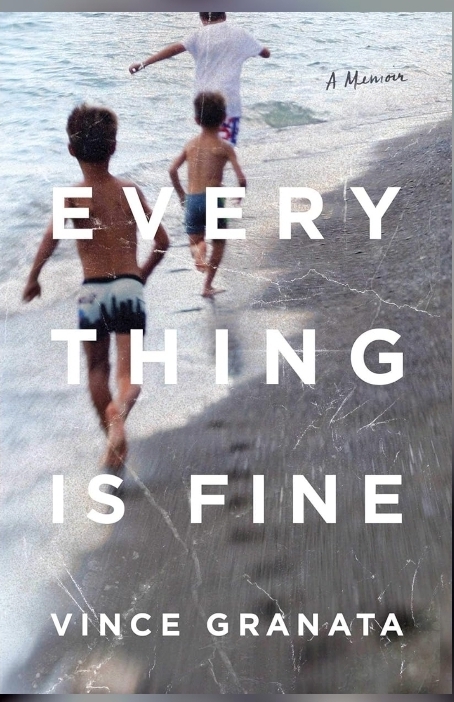
Book Review: EVERYTHING IS FINE


Title: Everything Is Fine  

Author: Vince Granata

Publisher: Atria Books

Pages: 303

My GoodReads Rating: ⭐


Vince Granata was an only child until age 4 when the miracle of IVF gave him three siblings. Triplets Christopher, Timothy and Elizabeth looked up to him, had raucous playtime sessions with him and built many lovely memories together.


Twenty years later, Timothy became schizophrenic, and from there stemmed the biggest tragedy of their lives as a family when Tim stabbed their mother Claudia to death. While Christopher and Elizabeth cannot imagine someone they shared a womb with acting out as he did, their father continues to stand by Tim and his need for medical aid, while Vince takes it upon himself to understand schizophrenia in an attempt to make sense of their lives and so as not to lose sight of his own love for Tim.


The writing is moving and kind, as Vince throws light on the family dynamics, the love that bound them together and the illness that stabbed the core of the family. As Vince shares the happy memories of his family, we are given a glimpse into how Tim’s mind betrayed him, twisting those memories around.


At every step, Vince has taken his role seriously: as his parents’ deputy and as chronicler of the tragedy that has befallen them. Even as a grown man, he sees himself as his mother’s deputy, wanting to forgive and understand his brother.


Vince dips into his memories to remind himself of all that was good about Tim and how schizophrenia took it away.


The author gives us an understanding of schizophrenia, how the illness sneaks up not only on the affected person, but also on the family. The book fills you with compassion for those suffering from mental illness, which we all fear and look upon with distaste.


The book is both deeply personal and well researched. The author drowned himself in books and studies about schizophrenia. He tells us about the laws governing the treatment of schizophrenics in the US, about his fears that he failed his brother.


The research is not limited to reading alone. The author has spent time talking to family members of those affected by schizophrenia, doctors and social workers and patients living with schizophrenia.


To those of us who use the word, schizophrenia, as an insult or a slur, this book is an eye-opener. The author calls for more schizophrenia stories to widen our awareness of the illness.


The name of the book comes from the phrase, Everything is Fine, which Vince’s mom used to use to preface her texts to him, when giving him updates about Tim. Everything is Fine was a way of de-escalating the situation, preventing the buildup of stress, until the time when the word, but, needed to be appended to the phrase.


(I read this book on NetGalley. Thank you to the author, the publisher and NetGalley.) 


Monday, March 09, 2020

Book Review: INLAWS AND OUTLAWS

Title: Inlaws and Outlaws
Author: Kate Fulford
Publisher: Thistle Publishing
Pages: 296
My GoodReads Rating: 


Evelyn “Eve” is still in the early stages of a relationship with her professor boyfriend Gideon Rowe when she meets his parents, Malcolm and Marjorie, only to face the thinly veiled hostility and manipulation of his mother.

Gideon, though not exactly a mamma’s boy, believes that his mother is an amazing woman, all because she donated one of her kidneys to a stranger’s kid. So it’s all the more necessary to be accepted by her.

Marjorie does everything she can to thwart Eve and prevent her from marrying Gideon. The measures she invokes involve high-level melodrama and it seems that everyone, but Gideon, can see through them. Even Joe, the husband of Gideon’s sister, Helen, warns Eve to watch her back in the presence of Marjorie. He tells her that Marjorie thinks she alone knows what is best for her family.

But is Eve as nice as Gideon thinks she is? Not quite. She has her own secrets, which include a prior marriage, one that Gideon has no idea about. She makes it her business to find out more about the family, and stumbles upon Meg, Marjorie’s identical twin, who can’t get along with Marjorie at all and who hints at a deeper secret, one that might help find her way through the problem that is Marjorie.

But the enemy is a formidable one. Will Eve be able to marry Gideon? Or will she be yet another casualty?


The book is written in the past tense PoV of Eve. There is a self-deprecatory tone in her PoV that adds to her appeal.

I liked the author’s style of writing, the turns of phrases, the subtle humour, the observations about people that we read in Eve’s account. I loved this line: I felt very much as rats must when they are put into mazes by people in white coats.

Eve’s humour showed her felicity with the English language, a skill which reminded me of PG Wodehouse, though not quite at the same level. I liked the manner in which she casually used a particular skill, and then in an offhand manner, told us that she had worked there before. The list of places in which she has worked before include work with a detective, a lawyer, a researcher and even a realtor. These are all workplaces that she ended up leaving because she didn’t play by the rules, but the skills come in handy as she tries to find the chink in Marjorie’s armour. It is as if her whole life has been a preparation for her run-in with Marjorie.

The only thing I didn’t like about Eve was that she didn’t have a steady job and that made her seem like a sponge.

The characters are all well drawn.

Eve hasn’t known a happy family life and I could understand her need to want Gideon’s parents to like her. Having lost her parents at the age of six, she was raised by her aunt Audrey, who was emotionally distant from her. Younger brother Dominic was raised by other relatives. Eve hopes that the Rowes will be her own family someday.

There is a subplot related to Dominic and his ex-girlfriend Sophie, and their 9-year-old daughter, Pixie, who Eve is quite fond of, and to save whom she even jumps into the water. The jumping into the water to save a drowning person is a motif that is used to great effect here.

If there was one thing I didn’t understand, it was Eve’s friendship with Claire. Despite being a highly qualified person, Claire didn’t seem to have any great insights for Eve. Maybe her only reason for being a part of this story was so that Eve could use her as a sounding board.

At the beginning, I wasn’t sure what to make of Eve. There was so much she wouldn’t share with us, so many secrets she held. When she did share her secrets, there was no slow build-up to them, but a sudden full-blown revelation, indicating that she clearly enjoys shocking the reader. She also admits that Gideon’s posh house was a factor in the all-out move she made towards him.

She asks us, Why do so many people lie… especially when they are so bad at it. I could sense that Eve wasn’t completely reliable as a narrator, that there was something she was hiding, but what that was I couldn’t tell. Also, Malcolm and Gideon too behave oddly.

But then a few chapters later, I began to warm towards her. Partly because of the insidious manner in which Marjorie plays a game. Believe me, you don’t want a mother-in-law like her.

Since this is a first person past tense PoV of Eve, we can’t look into the workings of Marjorie’s mind, but it isn’t hard to realise the lengths to which this woman might go to destroy Gideon’s romantic relationships. The hard-headed Claire insists they are all coincidences, but we’re smarter than Claire. We can see through Marjorie’s attempts.

There was a twist ending and I particularly liked the resolution.

The title was apt and gave us a foretaste of the fireworks that we could expect from the story.

(I read this book through NetGalley.)

Wednesday, December 18, 2019

Book Review: SURVIVING GOODBYE

Title: Surviving Goodbye
Author: Morgan Parker
Publisher: QuoteStork Media, Inc
Pages: 234
My GoodReads Rating:


Elliot Fitch, a quintessentially good guy, loses the love of his life, Karen, to a terminal disease. On her deathbed, Karen tells him that their daughter, Elena, is not his.


A year after Karen’s death, Elliot is still consumed by hate and is a floundering mess. He has not gone to work, and just hangs around the house, eating takeout and letting his 16-year-old daughter, Elena, manage herself as best as she can. His wife’s revelation is eating at him, and he can’t help but torture himself with thoughts of who Elena’s real father could be and how he managed to be deceived so badly.


When Elena tells him that she is pregnant, as a result of trying to seek affection elsewhere after Elliot checked out mentally, and that the father of her child is not interested in being a part of her life anymore, Elliot decides to find out who her biological father is and help Elena out.

This is followed by some crazy adventures as Elliot gets into all kinds of wild goose chases to get to the bottom of the mystery. Along the way, he befriends Veronica, a single mother who works as a delivery girl. Veronica offers to help Elliot out in his quest. In doing so, she slowly becomes a part of his life.

But how are they going to find the truth when there are absolutely no leads, and the only person who knew the truth is dead?


The story is written in the first person PoV of Elliot, who comes across as a good guy, but not a sensible one.

What I couldn’t stand was the language; it was atrocious. I could let some examples of bad language slip by, if it was required, but here it just went on too long. 

None of the characters were well developed. I didn’t feel convinced about anyone’s motivations. 

Plus the ending was completely lame and farfetched.

There’s a self-deprecatory reference to the author in this book when Jamie, Karen’s brother, says, “I’ve read Morgan Parker novels that made better sense.”

I can’t say the same unfortunately.

Wednesday, March 27, 2019

Book Review: TOMORROW THERE WILL BE SUN

Title: Tomorrow There Will Be Sun
Author: Dana Reinhardt
Publisher: Pamela Dorman Books
Pages: 288
My GoodReads Rating: ⭐⭐


Tomorrow There Will Be Sun represents the hope of the protagonist, Jenna Carson, that no matter how rainy and dreary the situation may be today, it could all change for the better on the morrow.

Jenna books her own family and that of her husband Peter’s best friend Solly into a villa in Mexico. It is supposed to be a week-long dream vacation with breathtaking ocean views and unlimited margaritas. Solly’s family consists of his wife, Ingrid, their 5-year-old son Ivan, and 17-year-old Malcolm, Solly’s son from his first wife, Maureen.

They are here to celebrate Peter’s 50th birthday, three days later, and Solly’s too, some months hence.

As expected, the dream vacation quickly unravels. Jenna’s daughter, 17-year-old Clem, spends most of her time online, distant from her parents, or in the company of Malcolm, who has been in trouble with the authorities and has been expelled from his school. On the very first day, Peter gets a call from Gavriella, his gorgeous assistant and lies to Jenna about the nature of the call. Could he be having an affair?

To complicate matters further, Jenna is dissatisfied about a number of things. Having published three successful YA books, she is unhappy at facing writer’s block while she works on her fourth, already two months overdue for submission to her publisher. On the other hand, Ingrid, at work on her first book, is breezing ahead with inspiration at 1000 words a day and has turned out a fabulous book.

Also, Jenna has recovered from cancer, a fact that Peter doesn’t seem to take seriously.

She is also displeased with how much Solly seems to take Peter for granted. They are business partners, but Peter works longer hours while Solly earns more.

No matter how hard she tries, it seems as if all that Jenna touches turns bad: her relationship with her daughter, with her husband, even her writing. Will this dream vacation tighten the bonds that hold families and couples together or will it undo everything that Jenna has worked hard to build?


The week of the dream vacation coincides with the culmination of the Christian period of Lent, the Holy Week. But since the characters were either Jewish or atheist, the symbolism that might have been utilized to good effect was not capitalized on.

I felt sorry for Malcolm, who feels out of place in his father’s new family, and whose efforts are snubbed.

I liked the fact that Jenna was a writer, worried about characters and plot, voices and narratives and story arcs.

The action, however, isn’t all that interesting, and the dynamic between the couples doesn’t hold more than a passing interest.


(I received an ARC from First to Read).

Wednesday, July 25, 2018

Book Review: THE INTERMISSION

Title: The Intermission
Author: Elyssa Friedland
Publisher: Berkley Books
Pages: 368
My GoodReads Rating: ⭐⭐⭐


The book starts with the Prologue when newly married Jonathan and Cass Coyne predict that they will be happily married for over 50 years. Five years later, in Chapter 1, we see that they have drifted apart. Their sex life has reduced to a bare minimum, and they are going through the motions, barely connecting on any significant level.

The situation comes to a head when Cass, who works in a theatrical ad agency and believes that any play can benefit from an intermission, decides that that mode of treatment can be just as effectively transposed to her marriage.

Bemoaning the loss of the spark between them, Cass proposes an intermission of six months, time apart to save the marriage before they have a baby. Once a month, they will meet to exchange custody of their pet dog, Puddles.

Anxious to make the most of the intermission, Cass leaves for California, as far from Jonathan and their NY home as possible. She hopes to regain control of her life, but in a short while, both she and Jonathan will find their lives taking unexpected turns. Will they find their way back to each other or will the distance between them grow too wide to be spanned? Is Cass about to get more than she bargained for?


The quirky book cover reflects the dynamics of their marriage, sleeping apart, bound only by Puddles, the unifying factor between them. 

The book is divided into three parts, with Act One – Together, Act Two – Intermission, and Act Three – After.

It is written in the third person past tense point of view of both Jonathan and Cass, in alternate chapters. At first it seemed to me that the point of view should have been first person. But then I realized that the author’s omniscient PoV was better since they were not yet ready to come clean with each other. There were plenty of secrets that they were still in denial about. Secrets that they would have to come clean with. Secrets that we already know about thanks to the flashbacks neatly scattered throughout the story.


Like any marriage, theirs begins with noble intentions. Cass tells herself that she will never say no to Jonathan for sex. But then married sex becomes a chore. And the irritations of daily life begin to sap their energy. The act of living with someone with different habits, eccentricities, and a whole different upbringing and background, takes a toll. As anyone who is married learns, not that we love our spouses the less, but that they irritate us the more. And eventually, the love gets tarnished by the constant abrasions.

It got me thinking of the differences we bring to our marriage. How we never reconcile ourselves to them completely. How men and women are different. How each finds the other complicated.

How we are not upfront with each other. Thoughts left unsaid were often weightier than words spoken out loud. Marriage becomes a battleground when niceties feel like expletives.

The burden of expectations weighs heavily. Cass believes that Marriage shouldn’t mean becoming one person, with each spouse swimming inside the other’s private thoughts. No, the best relationships were built like Venn diagrams of two overlapping circles, where the only variable was how big the shared part was and how much remained for the individual.

We come to know of the lies that are a part of every marriage. To be married, you have to be willing to accept certain fictions. And of how parenting and its responsibilities leaves men and women on different pages.

Eventually, spouses begin to keep score. Like an accountant maintaining a ledger of checks and balances.


As outsiders, looking in, we can smile at the chinks in their marriage, particularly if we can relate to them. As insiders, spouses are often too busy trying to claw their way out. 

And so it is that we learn that Jonathan probably has a permanent indentation from biting his tongue. It comes from his tolerating her bad habits, while she is totally vocal about his. His silences, as much as her complaints, lead to resentments.

The Intermission is not just about the marriage of Jonathan and Cass. We also learn more about the marriage of Jonathan’s parents, with his father’s constant affairs; Cass’ mother’s relationships with losers; the marriage of Jemima and Henry Wentworth.

Through the wedding of Jonathan’s youngest brother, Michael and his fiancée, Jordyn, we see how cheesy weddings can be. It’s also a reminder of how over-prepared we are for weddings, and how ill-prepared we are for marriages.

As characters, Jonathan and Cass are opposites not only in upbringing, but in the fact that their meeting years after college is serendipity, or so he thinks, while she knows that she engineered it.

In Jonathan’s words, Cass is the type of woman who requires much work. This we know too. Losing her job after the agency where she works closes down when her boss dies of cancer, Cass begins to overthink, resulting in Death by Detail for us.

Jonathan’s views encapsulate the belief that it doesn’t matter where you whet your appetite, just as long as you come home for dinner. On the other hand, Cass wouldn’t dream of looking at another man while she was married.

During the intermission, Cass makes it clear that they are both free to sleep with whoever they want to. This time, it is Jonathan who finds the thought initially unpalatable.

In the person of Cass, we see women’s tendency to expect men to mind-read, where everything becomes a test where you have to give the right answer. It is indeed exasperating, a habit I’ve tried to outgrow, but it creeps up on me now and again. It wasn’t a trick or a trap or a test. There was no “right” answer.

The six months, spread over 368 pages, felt too long. I could not understand Cass’ constant flip-flops over where their marriage was.

I couldn’t wait for them to end, and by them, I mean the intermission and the pages. In the end, my sympathies were firmly with Jonathan.

At one point, Jonathan feels like a yo-yo.

So did I.


(I received an ARC from First to Read).


Tuesday, September 19, 2017

Book Review: THE WIFE BETWEEN US

Title: The Wife Between Us
Author: Greer Hendricks and Sarah Pekkanen
Publisher: St Martin's Press
Pages: 352


The very title attracted me to this book. I knew, on reading the blurb, that it would be a rewarding thriller, and the Prologue made good on the promise. It showed an ex-wife stalking the beautiful woman who has replaced her in her former husband’s affections.

As we read the book, we become aware that Nellie is engaged to be married to Richard Thompson, hedge fund manager, and incredibly rich, and that Vanessa, Richard’s ex-wife, is determined not to let the marriage be solemnised.

Now divorced, Vanessa works as a sales attendant at Saks, lives with her mother’s sister, Aunt Charlotte, and has a drinking problem. 

Nellie is a pre-school teacher, who also waitresses at a downscale café. She is the only daughter of her divorced parents.


The story comes to us in the first person present tense point of view of Vanessa, the ex-wife, and the 3rd person past tense point of view of Nellie, the girl friend. 

The dual perspectives in different tenses help us to engage with the two characters in different ways. With Vanessa’s present tense, we know that she will be the one to upset Nellie’s world; with Nellie’s past tense, we learn that she is the one to whom things will happen.

And while we wait for Vanessa to upturn Nellie’s world, we find that our own has been upturned.


The jealous ex-wife, the naïve fiancée and the virtuous, loving husband are at the heart of this triangle, that’s how we see it, until our assumptions, every single one of them, get torn to shreds.


For nothing is as it appears in this book. And so while the stereotypical old name, Nellie, might conjure images of a naïve waif, Nellie has her own baggage, something that causes her to have nightmares and to sleep with deadbolts on her door.

Vanessa sounds very sophisticated, and yet she was scorned by her husband. But she is no victim. She can barely hold it together. She has a drinking problem and it is overwhelming her. She is in danger of losing her salesgirl job at Saks.


At first, we don’t know what went wrong between Vanessa and Richard; just that there was some deceit on the part of Vanessa that caused the rift. Vanessa’s failure to get pregnant for the 6th time causes Richard to drift apart. 

He blames her drinking habit and then he learns that she had been pregnant back in college, a fact that she failed to mention to him.


I liked the seamless manner in which the flashbacks were introduced into the current narrative. At first, we just get bits of memories from Nellie and Vanessa.

We hardly ever get to see things from Richard’s perspective, except as he appears to Vanessa and Nellie. 

He does truly appear to be too good to be true. We wonder what Vanessa did to lose a catch like him. What is the extent of the betrayal that Richard faces again and again from the women he loves? After all, Vanessa too had only been Richard’s second wife. Before her, there was another who deceived him. 

When Nellie recalls Richard’s words, She wasn’t who I thought she was and then, later when he tells her, Even when I’m not there, I’m always there with you, they take on ominous overtones.


It is in Chapter 10 that Vanessa makes the first suggestion relating to the woman who will replace her, Who will miss her when she disappears?


I didn’t dislike Vanessa, and that was my first cue that I wasn’t expected to, that my expectations were about to be blown away. She has had a hard life, with a father who passed away early and a mother who wasn’t there for her. She has made wrong choices, but she is not bad.

There were so many similarities between Vanessa and Nellie that I wondered if that was Richard’s type: new to the big city, naïve and innocent, and a little bruised by her past.


The authors play around cleverly with the memories, giving us a little at a time, so we can piece them together. Initially, we get Vanessa’s flashbacks, but not Nellie’s.

At first, the memories point towards one truth, and then gradually they acquire a different hue. As Vanessa recalls what really happened, not what she wants to imagine happened, she says, We all layer them over our remembrances; the filters through which we want to see our lives.

But maybe that is true of every marriage. Maybe being in love carries the requirement of filtered vision; perhaps it is so for everyone.


I liked Vanessa more than Nellie. Richard and Maureen, Richard’s sister, I didn’t like at all. They were too perfect for my liking. I thought that Maureen was hiding something.

It was at Chapter 18 that my assumptions about the plot and where it was headed were completely overturned. 

Every character got flipped over, the twists kept piling up and the scenario appeared anew. The best way to sum it up would be to say that nobody is what we think they are.

As Vanessa says, The full story is far too tangled and complex to unravel.


I’d definitely recommend this one.


(I read a Kindle edition of this book through NetGalley.)

Thursday, August 10, 2017

Book Review: WHEN YOU DISAPPEARED

Title: When You Disappeared
Author: John Marrs
Publisher: Thomas & Mercer
Pages: 350


The institution of marriage harbours some of the worst manifestations of cruelty. John Marrs’ debut thriller, When you disappeared, is a wonderful example of this harsh truth.


Simon Nicholson, plagued by some inner demon with reference to his marriage, leaves his wife, Catherine, and three young children, James, Robbie and Emily, and quietly walks out of the life that was his for 33 years, taking nothing with him and plunging his family into grief and trauma.

Twenty-five years later, he returns, to offer his wife a meagre apology and to let her know that it was a grave sin that she committed 28 years ago that drove him away. 

The truth, Simon knows, will break her. He hopes it will torture her, as it has tortured him.

Back then, Catherine is badly shaken, afraid that he is hurt or dead, but when police searches reveal nothing, she is forced to pick up the pieces of her life and move on, for the sake of her children. 

But they are broken pieces. On the way to rebuilding their lives, the homebound Catherine nearly loses her home, and is forced to sell all their possessions, in order to save it. She begins to work 18-hour days and takes up three jobs in order to be able to pay the bills, nearly losing herself to a spiraling alcohol addiction.

Why did Simon leave? What pushed him over the edge? 
These are questions that plague Catherine and us.

The only thing we know of that fateful day is that something unforgivable has torn the couple apart. They have also lost a child, Billy, but we don’t know how, only that the death was tragic, and that Catherine still bears the scars of that loss.

As each fills the other in about the events of the 25 years they have spent apart, we see how Catherine suffered while Simon prospered.

We learn how he moved from England, to France and then the US, his moral compass askew, stealing, committing identity theft, implicating an innocent person falsely on a charge of intent to sell narcotics, and setting fire to a hotel that he helped restore to its glory, snorting drugs and sleeping with young girls, and killing, anything to drive his family out of his mind, while Catherine struggles to do the right thing for her family, suffers a miscarriage and copes with her trauma alone, while trying to shield and protect the children.

As the truth about what transpired over the course of the 25 years they spent apart is revealed, their recollections alternate with each other’s, each in a different reality, growing further apart, until they converge on the answers and we come to the fateful truth of what went wrong in their marriage, 28 years ago, and what happened to Billy. Their diametrically opposite understanding of what happened is an eye opener.


There is no second guessing just what prompted Simon to leave. The author gives us no clues, revealing the truth so slowly, we can barely see the layers being prised apart.


The flashbacks, covering their lives over the course of the 25 years since Simon left, as well as the years of their childhood and other events in their past, are written in the first person past tense point of view of both Simon and Catherine. 

On the other hand, the revelation of the truth today is in third person past tense. All the accounts are preceded by qualifiers detailing time- and datelines.

The changes in the PoV helped me understand whether the narrative was in the past or the present. It felt as if the author had given them the first person in the flashback so they could be honest, hiding nothing, while in the present comes the reckoning in the third person.

Through the course of the decisions and the actions the characters take, we become aware of just who they are. 

When Simon tells us about his mother who walked in and out of their lives, we are better able to understand him. His fascination with the absent parent, his desire to run away from his responsibilities, to chase the wrong choices.

It is amazing how quickly Simon learns to be different from what he is. He is willing to put every moral code aside in his quest for self'ish'-fulfillment, including committing murder several times, to punish Catherine. At the core of this attitude is his belief that If you scratch the surface of something perfect, you’ll always find something rotten hidden beneath. Through his account, Simon showed himself to be so fickle and remorseless, I wondered what he found so unforgivable in Catherine.


I found it easier to relate to Catherine. I rejoiced in her success, and felt sorry for the children who, afraid their daddy had vanished, worried their mommy would too. I felt her pain at not having closure. In Catherine’s words, My husband’s disappearance still had a curiosity factor attached to it, like the village had its own Bermuda Triangle.


Years later, Catherine is in a good place, personally and professionally, but I ached at the thought of all that Simon had put her through. I wanted to reach into the pages and slap him hard.

The mainstay of this book are Simon and Catherine, but Marrs paints a strong picture of Steven and Baishali, Roger and Paula, Douglas, Simon’s mother, Doreen, and the other characters whose lives coincide with theirs.


The author must be commended for holding our interest and keeping us anxious to know more, even as the revelations slowly tumble out. I also appreciate Marrs’ keen grasp of a woman’s emotions, how Catherine must feel to know herself, at first widowed, and then cruelly abandoned by the only boy to whom she gave her heart.


The book was a pointed indicator of how parents define their children, and how while some like Catherine are hurt, yet don't inflict their hurt upon others, many are like Simon, choosing to do as they were done by, hurting twice as much as they were hurt.

Both Simon and Catherine were rejected by their mothers, and yet Catherine emerges as the greater among the two. She mothers her kids with love, despite suffering at the hands of parents who didn't care about her. 

On the other hand, Simon's father, though not his own, loves him. That still doesn't stop Simon from projecting his hurt on to others.

The lesson in it is that old adage about whether we let circumstances make us bitter or better. Catherine chose to be a far better mother to her kids than she ever had. Simon, on the other hand, persisted in the delusion that he had no choice but to act the way he did.


Although grownup stories aren’t supposed to carry morals, this one reminded me of the need for communication within relationships, and especially within marriage. 

How much trouble could have been eliminated if only Simon and Catherine had sought answers and solace from each other. Simon would not have disappeared and we would not have the emotion- and nerve-wracking novel that is When you disappeared.


(I read a Kindle edition of this book through NetGalley.)
LinkWithin

Related Posts Plugin for WordPress, Blogger...