Showing posts with label Fantasy. Show all posts

Sunday, April 27, 2025

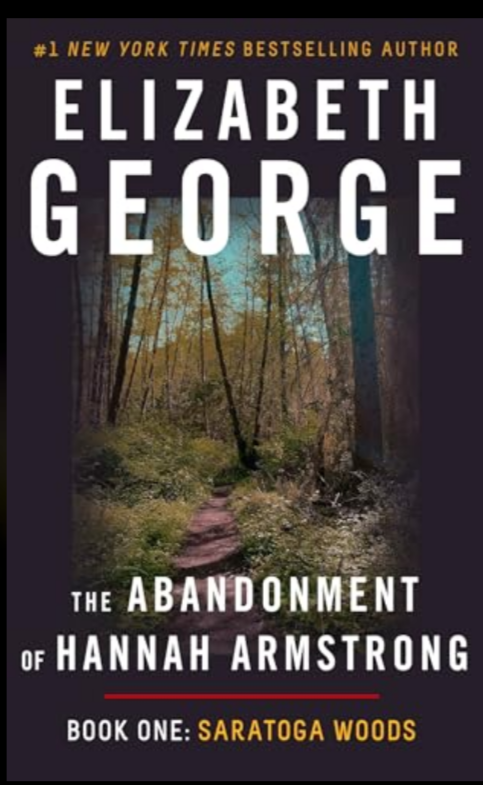
Book Review: THE ABANDONMENT OF HANNAH ARMSTRONG (BOOK ONE: SARATOGA WOODS)


Title: The Abandonment of Hannah Armstrong (Book One: Saratoga Woods)

Author: Elizabeth George

Publisher: Elizabeth George

Pages: 407

My GoodReads Rating: ⭐⭐⭐⭐


I signed up to read Saratoga Woods because I’m a big fan of Elizabeth George and enjoy reading her Inspector Lynley series. But I couldn’t quite get into this one at the beginning. It was a slow start.


When 14-year-old Hannah Armstrong’s stepfather, Jeff Corrie, turns out to be a criminal, a fact she learns about because she has the power to hear people’s thoughts, her mother, Laurel Armstrong, uproots them from California to Whidbey Island, near Seattle. With a new name, the young girl, now Becca King, is sent to live with her mom’s old friend, Carol Quinn, who has promised to shelter her.

When Becca reaches Whidbey Island, she learns that Carol has died of a heart attack. With Laurel unavailable on the burner phone, Becca has nowhere to go in a strange town.

When Derric, a new friend, has a nasty fall on a bike trail, he goes into a coma. The town sheriff, Dave Mathieson, who is also Derric’s adoptive father, is sure that the young girl who called 911, the owner of the burner phone, has something to do with the accident. Will Becca be able to stay out of trouble, or will it come looking for her?

It is up to Becca to sort through the confusion in her own mind, and stay afloat and out of trouble until her mom returns for her, while solving the mystery of who might have wanted to hurt Derric.


This is a coming-of-age story with fantasy elements. Besides Becca, there is another character who might have a supernatural power. But where the other person has the gift under control, Becca is still figuring out her way around it.

The story is written in the 3rd person omniscient PoV. The writing is more tell than show, which is the author’s style, but I still enjoyed it.

Here’s a sample of her metaphors:

The idea of missing someone was like the swooping of a bird too close to her face.

She came into the room like a tractor rolling over a field.

Debbie gave him the kind of look a teacher gives to a kid when she suspects there are lice crawling in his hair.


Elizabeth does a great job recreating Whidbey Island in our minds, a place where everyone knows everyone else.


In her most vulnerable state, Becca encounters a slew of characters. There’s Debbie Grieder, who offers her shelter in her motel, Diana Kinsale who is sympathetic towards her, Seth Darrow, a school dropout and musician who helps her, and Derric Mathieson, a boy from Uganda who she finds fascinating. Then there’s Jenn McDaniels who can’t stand Becca, Hayley Cartwright, Seth’s former girlfriend who he suspects broke up with him on account of Derric, Debbie’s grandchildren, Josh and Chloe, Seth’s grandfather, Ralph, and his dog, Gus, and Derric’s parents.


As befitting a series, Becca has individual subplots with Seth, Debbie, Diana, Derrick, Josh, Chloe and Jenn. Seth has subplots with Hayley, her parents, grandfather Ralph, dog Gus and Derric.


The stories of these characters converge in multiple ways. For the greater part, it all seems like delicate wisps of unconnected threads. It’s only at the end that they come together.

The first description we get for Becca comes from the most minor of minor characters and it’s not flattering, but by then, we’ve bonded so well with her, we don’t care. We feel sorry for Becca, stranded in a strange place with no safety net.


While I loved the book, there were some things that rankled. There are multiple characters whose names begin with the letter D. There’s Debbie Grieder, Diana Kinsale, Seth Darrow and Derric Mathieson. Why did the author flout the fundamental rule of not naming characters after the same letter?

I couldn’t understand the significance of the Paul Revere poem that Laurel keeps repeating, when she doesn’t want her daughter to listen to her thoughts. Perhaps its meaning will be clearer in the subsequent books.

The mystery of who pushed Derric hinges on a footprint but it’s odd that the police don’t ever latch on to that clue. The mystery itself is a slow burn; who hurt Derric takes a backseat to who was the girl who made the call to the police station.


While the main plot of this book ends on a successful note, the overarching story in the series shows up on the very last page, making the way for Book 2. I look forward to the next one in the series.


(I read this book on NetGalley. Thank you to the author, the publisher and NetGalley.) 


Wednesday, August 16, 2017

Book Review: THE LIAR'S WEAVE

Title: The Liar's Weave
Author: Tashan Mehta
Publisher: Juggernaut Books
Pages: 330


Zahan Merchant is born in 1904 to a Parsi family in Bombay. In this alternate world, the lives of humans are written in the stars, and mapped and charted by powerful astrologers, In-Betweens, who can tell you the year in which you will die and the facts of your life, based on the date, time and place of your birth. In their words, Everything happens, as it should happen, because it has already happened.

But the astrologers are powerless to interpret Zahan’s future, for, it seems, that the gods erred this once and Zahan has been born without one, or more accurately, and confusingly as astrologer Narayan Tarachand discovers, with almost infinite futures.

Tarachand takes the problem to his In-between friends, Krishna and Svasa.

The error of the gods gives Zahan his power: he can alter the weave of the future with his lies, a talent he discovers at age 7. It is a secret that he shares only with older brother, Sorab.

But there is a catch. Sometimes it is a power he has, and sometimes, it’s a power that frightens him. For he cannot see the realities he creates for others. Knowing the truth nullifies the effect of the lie.

There is a forest, Vidroha (Hindi for protest, rebellion), deep in the heart of Bombay, which is home to the hatadaiva, the ill-fated. Here Yaatri, a nomad from the Banjara tribe; Liling, Chinese medicine woman; acrobat Tamarin and his wife, Jia, both from the circus, hold court, inspired by Niyat, half-man, half-legend. They give succour to other ill-fated, while yearning to break the stranglehold of fate.

Yaatri meets Zahan and his best friend, Porthos, both 16, and invites them into Vidroha, hoping Porthos will re-write their fate. Meanwhile, the Sapta Puri, the seven holy universities, are equally interested in Zahan and how he alters the weft and warp of life.

Already new realities are coming about. Fortunates are suffering; the ill-fated have flashes of luck. But can you interfere with reality without suffering the consequences?

Vidroha’s desire to change their destinies will destroy lives. And neither Zahan nor Tarachand, who uses Zahan’s power to his own advantage, will come out of this unscathed.


The novel integrates ancient Indian myths with Hindu mythology, creating characters and locales that are part-truth and part-fiction, interspersing the mundane with the cosmic. It shows us how the lives of human beings pan out, while the astrologers attempt to play god. These are lines for us, lives for them, Tarachand chides himself. And yet, as the omniscient narrator reminds us, No matter what the wisdom of the stars, human imagination is stronger.

As a premise, it is intriguing and frightening. In the wrong hands, a power like Zahan’s could wreck lives. Horoscopes and birth charts are one belief that Parsis take as seriously as Hindus. But in this world, it seems, that everyone is held captive to the birth chart.


The story is written in the present tense, in the third person PoV of the characters. Interspersed with the main narrative are excerpts from Tarachand’s book, The Perspective of an In-between.

The similes used in the writing are earthy. Beard like unspun cotton. The prose is evocative, stylized, not as ordinary people might speak. But this is a fantastic world, and so it feels right.


The novel is set in Hindu Colony, Parsi Colony and in Vidroha, besides Benares. The writing in Vidroha is rich and dense, decadent and lush, while that in the two residential colonies is almost genteel, sparse and succinct, in comparison.

The story is set against the backdrop of the struggle against the British for independence. Zahan initially wants to use his dancing tongue to guide the fate of his country. But the struggle for Independence is merely a placeholder. In this alternate world, the astrologers study individual lives; they will not study the fate of the country, the narrator tells us.

There are a few historical facts that come up. The fact that the British introduced the Criminal Tribes Act, a piece of legislation that threatened the diversity of India and pronounced Yaatri and his people, the Banjaras, and hundreds of other tribes criminal.

Beyond a few cursory mentions, the author tells us nothing about it. And that made me feel cheated. Why not just make it a story about a boy who can lie the truth into existence? Why bring the fate of a country into the mix, if you do not mean to take it to its just conclusion?


The names of the leading characters, Yaatri, Tamarin, Liling, Umaan were unreal, fictional, and yet they seemed relatable. Yaatri signifies the journey, Porthos is a character from The Three Musketeers, while Zahan is as Yaatri describes him, Zzzz-haan. Like a bee and an exhale.

The characters have their own compulsions. Porthos wants to know if he is hatadaiva. The others in Vidroha want their ill-fortune transformed.

Tarachand, whose future decrees that he could be Dagdhavasta, head of Sapta Puri, is bothered by the anomaly of Zahan. If the gods have missed him, what else have they missed? If the gods have intended him, what is the purpose of that intention?

The author, young as she is, has a firm grasp of the emotions of the characters, as they struggle in vain to live their lives. The bond between the two brothers, Zahan and Sorab, was poignant, and I felt for Zahan, and the loss of his relationship with Sorab.


The world is being made anew, with every word from a liar’s mouth.

The author treats us to the psychology of the lie. You cannot, absolutely cannot, break eye contact… You must believe your lie, with every ounce of fibre you possess. Love it, nurture it, trust it.

The best lies are the ones between two truths.

What is a lie but a fictional story? And here, stories are described as The currency of your soul.


The novel teases you, confuses you but you bide your time, for as the narrator has told you, Secrets have to ripen before they can be diced; mysteries brew before they clear.


My beloved St Xavier’s College features in this book. Beyond it, it was fascinating to read about Bombay, my favourite city. This city lost so much of its character when its spirit was quelled, and it was asked to keep mum.

Mum-bai.

Why is it always women who are asked to shut up?


I was sorry to see Zahan go, at the end of the book. There seemed so much more that would happen in his life. Surely the gods would not let him go his peaceful way.

What is that thing they say about a liar? 
Once a liar... always a liar.


(I received a free copy of this book from Juggernaut Books for the purpose of a fair and honest review.)

Thursday, April 09, 2015

Dear Hermione Granger

To, 
Hermione Granger, 
Muggle-born, 
Student at Hogwarts, 
Sorted into Gryffindor, 
C/o JK Rowling, 
The Harry Potter series


Dear Hermione,

Growing up, I had a voracious appetite for facts and learning, one that I always kept hidden for fear of inviting smirks and a collective rolling of the eyes from my classmates. Who wants to be known as a Miss-Know-It-All?

That attitude isn’t conducive to winning friends. Who would know that better than you?

At first glance, both Harry and Ron were put off by you. But you won them over by the power of your intelligence and knowledge and your ferocious sense of loyalty.

Nor were you very popular for your tendency to speak your mind. The best thing about you was that you refused to dumb yourself down for anyone. You remained true to yourself, just like that wild, curly and unruly mop of hair on your head. Unwilling to be tamed or pruned.

Where there was a good fight to be fought, you jumped right in, whatever the consequences, whether that meant supporting Harry against He-who-shall-not-be-named or fighting for the rights of house-elves or standing up for people who couldn’t, or wouldn’t, stand up for themselves.

You devour books. Ron said it so well about you, “That’s what Hermione does. When in doubt, go to the library.” I like that about you. And yet you know that “Books! And cleverness! There are more important things – friendship and bravery.


Beneath your pushy exterior lies a warm and sensitive soul, one that is wounded when her friends make fun of her. One that feels insecure, and is mortally afraid of failure. It is this vulnerability that causes you to overcompensate by trying harder than anyone else, and sticking to a task long after everyone else has given up. Those fears make you real and acceptable.


Your image is also marred by the fact that you can be annoyingly bossy, always proposing to advise others on the best thing to be done, and taking offence when people do their own thing regardless. As you once said, “I’m going to bed before either of you come up with another clever idea to get us killed. Or worse, expelled.” Contrary to what Ron believed, you knew your priorities.


You were never one to suffer fools gladly. You once said to Ron, “Just because you’ve got the emotional range of a teaspoon doesn’t mean we all have.” How you ended up with Ron is a mystery. But I suppose characters, like real people, behave foolishly sometimes. 


Had I known you earlier, I might have imbibed some of your chutzpah, your disdain for their scorn (Draco called you a ‘mudblood’), I would have felt less conscious of those elements of my personality, surer of myself. 


You made a name for yourself in the Harry Potter universe without having any magical genes to back you. You put up with the resentment of the bluebloods in your fierce drive to become the best witch you could become.


It proves what I’ve always believed.


Who says Muggles can’t make magic?


You just have to believe in yourself.


LinkWithin

Related Posts Plugin for WordPress, Blogger...